

by Cora Currier ProPublica, Nov. 5, 2013, 2:23 p.m.
November 6: This story has been updated to reflect new developments.
Nearly six months ago, President Obama promised more transparency and tighter policies around targeted killings. In a speech, Obama vowed that the U.S. would only use force against a "continuing and imminent threat to the American people." It would fire only when there was "near-certainty" civilians would not be killed or injured, and when capture was not feasible. The number of drone strikes has dropped this year, but they've continued to make headlines. On Friday, a U.S. drone killed the head of the Pakistani Taliban. A few days earlier came the first drone strike in Somalia in nearly two years. How much has changed since the president's speech?November 6: This story has been updated to reflect new developments.
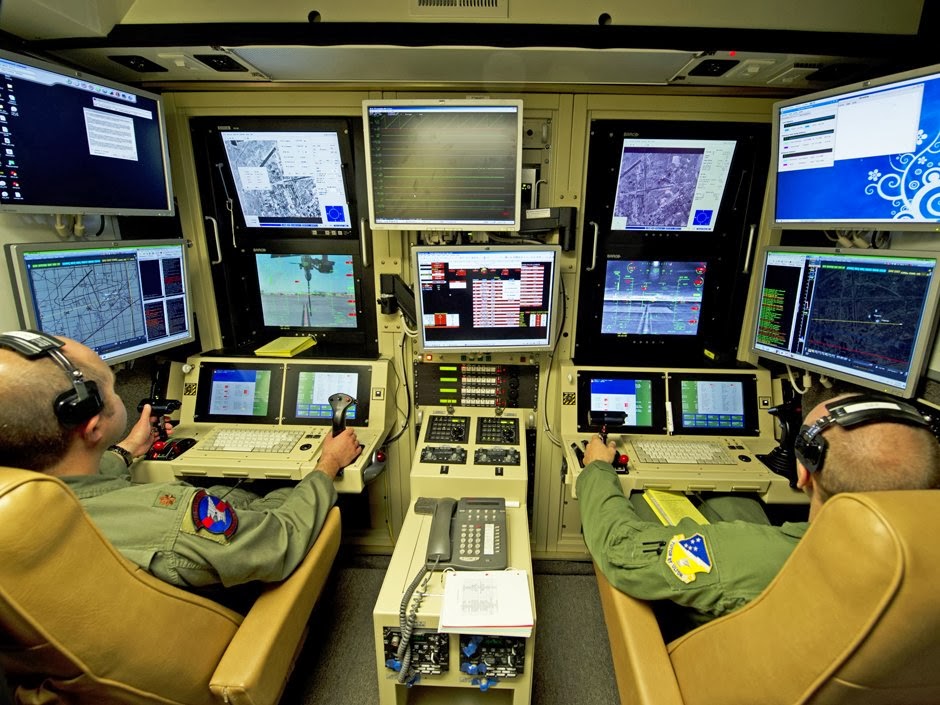 |
| Drone ground station (USAF). |
We don't know the U.S. count of civilian deaths
The administration says that it has a count of civilian deaths, and that there is a "wide gap" between U.S. and independent figures. But the administration won't release its own figures. Outside estimates of total civilian deaths since 2002 range from just over 200 to more than 1,000. The Pakistani government has given three different numbers: 400, 147, and 67. McClatchy and the Washington Post obtained intelligence documents showing that for long stretches of time, the CIA estimated few or no civilian deaths. The documents also confirmed the use of signature strikes, in which the U.S. targets people without knowing their identity. The CIA categorized many of those killed as simply "other militants" or "foreign fighters." The Post wrote that the agency sometimes designated "militants" with what seemed like circumstantial or vague evidence, such as "men who were probably' involved in cross-border attacks" in Afghanistan.
 |
| RQ-1 Predator aircraft, Tallil Air Base, (AB), Iraq. |
Attorney General Eric Holder confirmed only that four Americans have been killed by drone strikes since 2009: Anwar al Awlaki and his sixteen-year-old son, Abdulrahman, Samir Khan, and Jude Kenan Mohammed. Holder said that only the elder Awlaki was "specifically targeted," but did not explain how the others came to be killed. Although Obama said that this disclosure was intended to "facilitate transparency and debate," since then, the administration has not commented on specific allegations of civilian deaths.
We don't know exactly who can be targeted
The list of groups that the military considers "associated forces" of Al Qaeda is classified. The administration has declared that it targets members of Al Qaeda in the Arabian Peninsula, and "elements" of Al Shabaab, but there are still questions about how the U.S. determines that an individual belonging to those groups is in fact a "continuing and imminent threat." (After the terror alarm that led to the closing of U.S. embassies this summer, officials told the New York Times they had "expanded the scope of people [they] could go after" in Yemen.) This ties into the debate over civilian casualties: The government would seem to consider some people legitimate targets that others don't.
Amnesty International and Human Rights Watch conducted in-depth studies of particular strikes in Pakistan and Yemen, respectively. They include eyewitness reports of civilian deaths. (Most of the deaths investigated happened before the Obama administration's new policies were announced, although the administration has not said when those guidelines went into effect.) The reports also raised questions of the legality of specific strikes, questioning whether the deaths were all unavoidable casualties of legitimate attacks.It does not appear that the U.S. plans to expand strikes against Al Qaeda to other countries — officials have reportedly told Iraq, for example, it won't send drones there. But the U.S. has established a surveillance drone base in Niger, and fed information from drones to French forces fighting in Mali.
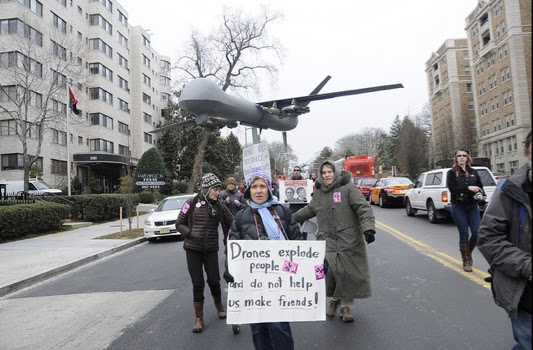 |
| "Drones Kill People" - Protesters at President Obama's inauguration 2012 (Photo: Debra Sweet). |
We don't know if the U.S. compensates civilian casualties
CIA director John Brennan suggested during his confirmation hearing that the U.S. made condolence payments to harmed families. But there is little evidence of it happening. U.S. Central Command told ProPublica that it had 33 pages related to condolence payments — but wouldn't release any of them to us.
We don't always know which strikes are American
While unnamed officials sometimes confirm that strikes came from U.S. drones, other attacks may be from Pakistani, Yemeni, or even Saudi planes. (It's also worth noting that the U.S. has also used cruise missiles and Special Forces raids. But the bulk of U.S. counterterrorism actions outside Afghanistan in recent years appear to rely on drones.)
We don't know the precise legal rationale behind the strikes
Some members of Congress have seen the legal memos behind targeted killing of U.S. citizens. But lawmakers were not granted access to all memos on the program. Legislation pending in the Senate would require the administration to give the Intelligence Committees a list of such legal opinions.
Other congressmen have introduced bills with more reporting requirements for targeted killings. (Proposals for a "drone court" for oversight have not gotten very far.)
 |
| "Reaper" Drone - Even deadlier than the Predator Drone. |
And here are some things we've learned through leaks and independent reporting:
How the U.S. tracks targets: Documents provided by Edward Snowden to the Washington Post detailed the NSA's "extensive involvement." Lawyers in a terrorism-related case also uncovered reports that government surveillance of their client may have led to a drone strike in Somalia. The Atlantic published a detailed account of Yemen using a child to plant a tracking chip on a man who was killed in a U.S. strike.
What people in the countries affected think: The Pakistani government's cooperation with at least some U.S. drone strikes—long an open secret—has now been well-documented. Public sentiment in the country is vividly anti-drone, even when violent Taliban commanders are killed, and politicians continue to denounce them as American interference. Limited polling in the region most affected by drones is contradictory, with some saying that at the very least, they prefer drones to the Pakistani military campaigns. Life in those areas is between a drone and a hard place: Residents told Amnesty International of the psychological toll from drones, and they also face reprisals from militants who accuse them of spying.
 |
| A Predator drone fires a missile. |
The physical infrastructure: More of the network of drone bases across the world has been revealed — from the unmasking of a secret base in Saudi Arabia to the fact that drones had to be moved off the U.S. base in Djibouti, in the Horn of Africa, after crashes and fear of collision with passenger planes.
The CIA's role: The administration had reportedly planned to scale back the CIA's role in targeted killing, moving control of much of the drone program to the military. But the CIA reportedly still handles strikes in Pakistan and has a role in Yemen as well. Officials told Foreign Policy yesterday that the transition won't happen anytime soon.
The history of the programs: Revelations continue to change our understanding of the contours of the drone war, but two books published this year offer comprehensive accounts — The Way of the Knife, by Mark Mazzetti of the New York Times, and Dirty Wars, by Jeremy Scahill.

Reprinted with permission from ProPublica.


