Global Perspectives Now Global Perspectives Now
Showing posts with label collateral damage. Show all posts

The Dynastic Hillary Bandwagon: Bad for America

The Hillary Clinton for President in 2016 bandwagon has started very early and with a purpose. The idea is to get large numbers of endorsers, so that no Democratic Primary competitors dare make a move.  These supporters include Senator Chuck Schumer (D-NY), financier George Soros and Ready for Hillary, a super PAC mobilizing with great specificity (already in Iowa).

By Ralph Nader 
Given this early bird launch, it is important to raise the pressing question:
Does the future of our country benefit from Hillary, another Clinton, another politician almost indistinguishable from Barack Obama’s militaristic, corporatist policies garnished by big money donors from Wall Street and other plutocratic canyons?

Caricature: DonkeyHotey
There is no doubt the Clintons are syrupy political charmers, beguiling many naïve Democrats who have long been vulnerable to a practiced set of comforting words or phrases camouflaging contrary deeds.

Everybody knows that Hillary is for women, children and education. She says so every day. But Democrats and others can’t get the Clintons even to support a $10.50 federal minimum wage that would almost equal the 1968 minimum wage, inflation-adjusted, and would raise the wages of 30 million workers mired in the gap between the present minimum wage of $7.25 and $10.50 an hour. It just so happens that almost two-thirds of these Americans are women, many of them single moms struggling to support their impoverished children. Nearly a million of these workers labor for Walmart, on whose Board of Directors Hillary Clinton once sat. Words hide the deeds.

As a Senator on the Senate Armed Services Committee, Hillary had to start proving that women, just like the macho men, can be belligerent and never see a weapons system and its use that they didn’t like. Never did she demonstrate any ongoing interest in debloating the massive, wasteful, duplicative military budget so as to free up big monies for domestic public works programs or other necessities.

As Senator she also admitted that she didn’t have time to read a critical National Intelligence Estimate Report, which had caveats that might have dissuaded her from voting with George W. Bush to invade Iraq in 2003. War-mongering and wars of Empire never bothered her then or now. Just a few weeks ago, she was photographed giving the recidivist war criminal, Republican Henry Kissinger, a big, smiling hug at a public event. It’s all part of the bi-partisan image she is cultivating under the opportunistic banner of “cooperation.” (For more information, read the New York Times’ Collateral Damage and Nixon and Kissinger’s Forgotten Shame, or Seymour Hersh’s The Price of Power: Kissinger in the Nixon White House.)

As Secretary of State, Hillary Clinton accelerated the Department’s militarization, belting far more war-like, threatening assertions toward governments of developing countries than did the Secretaries of Defense. She loved to give speeches on “force projection,” the latest synonym for “the Empire,” and “the pivot” toward East Asia and against the asserted looming threat of China. Taking due note, the Chinese generals demanded larger budgets.

George Soros: a "power behind the throne?" (Photo: Niccolò Caranti)
The Secretary of State’s highest duty is diplomacy. Not for her. Despite her heavy travelling, she made little or no effort to get the government to sign onto the numerous international treaties which already had over a hundred nations as signatories. These include stronger climate change agreements and, as Human Rights Watch reports, unratified treaties “relating to children, women, persons with disabilities, torture, enforced disappearance and the use of anti-personal landmines and cluster munitions.” These tasks bore her.

Much more exciting was military action. Against the wishes of Secretary of Defense Robert Gates, she pulled Barack Obama into the Libyan war. There were consequences. Libya is now in militia chaos, having spilled over into Mali, but without Gaddafi, its overthrown dictator who had disarmed and was making peace with western nations and oil companies.

As a Yale Law School graduate, she was not in the least bothered that the attack on Libya occurred without any Congressional declaration, authorization or appropriation of funds – a classic Madisonian definition of impeachable high crimes and misdemeanors.

Like Bill Clinton, she is an unabashed cheerleader for corporate globalization under NAFTA, the World Trade Organization and the proposed sovereignty-stripping, anti-worker Trans-Pacific Partnership Free Trade Agreement. Secretary of State Clinton, in the words of trade expert Jamie Love, "put the hammer to India when the government took steps to grant compulsory licenses on cancer drug patents."

Even regarding the easy clampdown on waste and fraud, Hillary Clinton fired Peter Van Buren, a 24-year-Foreign Service Officer, who exposed such waste and mismanagement by corporate contractors in Iraq. (For more information, see http://wemeantwell.com/).

Foreshadowing this season’s headlines, former Secretary of State Clinton ordered U.S. officials to spy on top UN diplomats including Secretary General of the UN, Ban Ki-Moon, and those from the United Kingdom. She ordered her emissaries around the world to obtain DNA data, iris scans and fingerprints along with credit card and frequent flier numbers. Not only was this a clear violation of the 1946 UN convention, but after admitting what happened she didn’t even make a public apology to the affected parties.

Under her watch, the advice and status of the Department’s foreign service officers and aid workers were marginalized in favor of the militarists – and not only in Iraq.

Many Wall Streeters like Hillary Clinton. Expecting their ample contributions, and socializing with their business barons, it is not surprising that Hillary Clinton avoids going after the crooked casino capitalism that collapsed the economy, drained investors, pensions, jobs and taxpayer bailouts. Hillary Clinton is a far cry from the stalwart Senator Elizabeth Warren on this towering pattern of unaccountable corporate abuse.

The surreal world of Hillary Clinton is giving $200,000 speeches, collecting prestigious awards she does not deserve, including one from the American Bar Association, and basking in the glory of her admirers while appropriately blasting the Republicans for their “War on Women” – the safe refrain of her forthcoming campaign.

It is true that the Republican madheads make it easy for any Democratic candidate to judge themselves by the cruel, rabid, ravaging Republicans. But, is that the kind of choice our country deserves?

A Clinton Coronation two years or more before the 2016 elections will stifle any broader choice of competitive primary candidates and more important a more progressive agenda supported by a majority of the American people.

Full Medicare for all, cracking down on corporate abuses, a fairer tax system, a broad public works program, a living wage, access to justice and citizen empowerment, clean election practices, and pulling back on the expensive, boomeranging Empire to come home to America’s necessities and legitimate hopes are some examples of what the people want.

Maybe the sugarcoating is starting to wear. Columnist Frank Bruni, writing in the New York Times (Hillary in 2016? Not so Fast), reports her polls are starting to slump. Apparently, as Bruni suggests, she’s being seen as part of the old Washington crowd that voters are souring on.

As I wrote to Hillary Clinton in early summer 2008, when calls were made by Obama partisans for her to drop out, no one should be told not to run. That’s everyone’s First Amendment right. However, not voting for her is the prudent decision.

____
Ralph Nader is a consumer advocate, lawyer, and author. His latest book is The Seventeen Solutions: Bold Ideas for Our American Future. Other recent books include, The Seventeen Traditions: Lessons from an American Childhood, Getting Steamed to Overcome Corporatism: Build It Together to Win, and "Only The Super-Rich Can Save Us" (a novel).


Reprinted with permission from Common Dreams. 

6 Months After Obama Promised to Divulge More on Drones, Here's What We Still Don't Know

by Cora Currier ProPublica, Nov. 5, 2013, 2:23 p.m.
November 6
: This story has been updated to reflect new developments.
Nearly six months ago, President Obama promised more transparency and tighter policies around targeted killings. In a speech, Obama vowed that the U.S. would only use force against a "continuing and imminent threat to the American people." It would fire only when there was "near-certainty" civilians would not be killed or injured, and when capture was not feasible. The number of drone strikes has dropped this year, but they've continued to make headlines. On Friday, a U.S. drone killed the head of the Pakistani Taliban. A few days earlier came the first drone strike in Somalia in nearly two years. How much has changed since the president's speech?

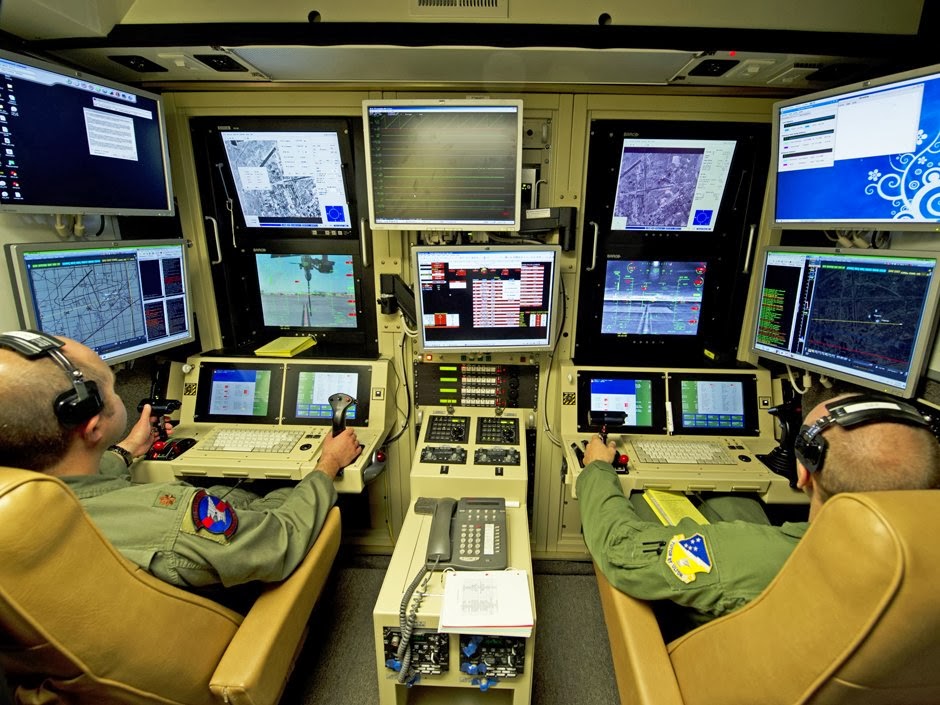
Drone ground station (USAF).
 
We don't know the U.S. count of civilian deaths

The administration says that it has a count of civilian deaths, and that there is a "wide gap" between U.S. and independent figures. But the administration won't release its own figures. Outside estimates of total civilian deaths since 2002 range from just over 200 to more than 1,000.  The Pakistani government has given three different numbers: 400, 147, and 67. McClatchy and the Washington Post obtained intelligence documents showing that for long stretches of time, the CIA estimated few or no civilian deaths. The documents also confirmed the use of signature strikes, in which the U.S. targets people without knowing their identity. The CIA categorized many of those killed as simply "other militants" or "foreign fighters." The Post wrote that the agency sometimes designated "militants" with what seemed like circumstantial or vague evidence, such as "men who were probably' involved in cross-border attacks" in Afghanistan.

RQ-1 Predator aircraft, Tallil Air Base, (AB), Iraq.
The administration reportedly curtailed signature strikes this year, though the new guidelines don't necessarily preclude them. A White House factsheet released around Obama's speech said that "it is not the case that all military-aged males in the vicinity of a target are deemed to be combatants." It did not say that people must be identified. (In any case, the U.S. has not officially acknowledged the policy of signature strikes.)

Attorney General Eric Holder confirmed only that four Americans have been killed by drone strikes since 2009: Anwar al Awlaki and his sixteen-year-old son, Abdulrahman, Samir Khan, and Jude Kenan Mohammed. Holder said that only the elder Awlaki was "specifically targeted," but did not explain how the others came to be killed. Although Obama said that this disclosure was intended to "facilitate transparency and debate," since then, the administration has not commented on specific allegations of civilian deaths.

We don't know exactly who can be targeted
The list of groups that the military considers "associated forces" of Al Qaeda is classified. The administration has declared that it targets members of Al Qaeda in the Arabian Peninsula, and "elements" of Al Shabaab, but there are still questions about how the U.S. determines that an individual belonging to those groups is in fact a "continuing and imminent threat." (After the terror alarm that led to the closing of U.S. embassies this summer, officials told the New York Times they had "expanded the scope of people [they] could go after" in Yemen.) This ties into the debate over civilian casualties: The government would seem to consider some people legitimate targets that others don't.
 
Amnesty International and Human Rights Watch conducted in-depth studies of particular strikes in Pakistan and Yemen, respectively. They include eyewitness reports of civilian deaths. (Most of the deaths investigated happened before the Obama administration's new policies were announced, although the administration has not said when those guidelines went into effect.) The reports also raised questions of the legality of specific strikes, questioning whether the deaths were all unavoidable casualties of legitimate attacks.It does not appear that the U.S. plans to expand strikes against Al Qaeda to other countries — officials have reportedly told Iraq, for example, it won't send drones there. But the U.S. has established a surveillance drone base in Niger, and fed information from drones to French forces fighting in Mali.

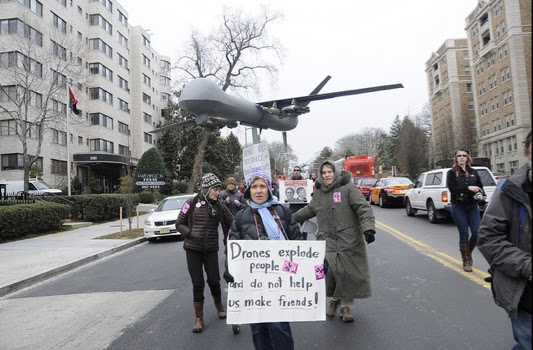
"Drones Kill People" - Protesters at President Obama's inauguration 2012 (Photo: Debra Sweet).


We don't know if the U.S. compensates civilian casualties
CIA director John Brennan suggested during his confirmation hearing that the U.S. made condolence payments to harmed families. But there is little evidence of it happening. U.S. Central Command told ProPublica that it had 33 pages related to condolence payments — but wouldn't release any of them to us.

We don't always know which strikes are American
While unnamed officials sometimes confirm that strikes came from U.S. drones, other attacks may be from Pakistani, Yemeni, or even Saudi planes. (It's also worth noting that the U.S. has also used cruise missiles and Special Forces raids. But the bulk of U.S. counterterrorism actions outside Afghanistan in recent years appear to rely on drones.)

We don't know the precise legal rationale behind the strikes
Some members of Congress have seen the legal memos behind targeted killing of U.S. citizens. But lawmakers were not granted access to all memos on the program. Legislation pending in the Senate would require the administration to give the Intelligence Committees a list of such legal opinions.
Other congressmen have introduced bills with more reporting requirements for targeted killings. (Proposals for a "drone court" for oversight have not gotten very far.)

"Reaper" Drone - Even deadlier than the Predator Drone.
It's far from clear that any of that additional oversight would lead to public disclosure. The government and the American Civil Liberties Union and the New York Times are still locked in court battles over requests for drone documents. While a judge has ruled the CIA can no longer assert the "fiction" that it can't reveal if it has any interest in drones, the agency hasn't been compelled to release any information yet. The government has also so far fought off disclosure of legal memos underpinning targeted killings.

And here are some things we've learned through leaks and independent reporting:
How the U.S. tracks targets: Documents provided by Edward Snowden to the Washington Post detailed the NSA's "extensive involvement." Lawyers in a terrorism-related case also uncovered reports that government surveillance of their client may have led to a drone strike in Somalia. The Atlantic published a detailed account of Yemen using a child to plant a tracking chip on a man who was killed in a U.S. strike.

What people in the countries affected think: The Pakistani government's cooperation with at least some U.S. drone strikes—long an open secret—has now been well-documented. Public sentiment in the country is vividly anti-drone, even when violent Taliban commanders are killed, and politicians continue to denounce them as American interference. Limited polling in the region most affected by drones is contradictory, with some saying that at the very least, they prefer drones to the Pakistani military campaigns. Life in those areas is between a drone and a hard place: Residents told Amnesty International of the psychological toll from drones, and they also face reprisals from militants who accuse them of spying.

A Predator drone fires a missile.
Yemen's president continues to openly embrace U.S. strikes, though the public generally opposes them —particularly those strikes that hit lower-level fighters, or those whose affiliations with Al Qaeda aren't clear. Foreign Policy recently detailed the aftermath of an August strike where two teenagers died. Their family disputes they had any link to terrorism.

The physical infrastructure: More of the network of drone bases across the world has been revealed — from the unmasking of a secret base in Saudi Arabia to the fact that drones had to be moved off the U.S. base in Djibouti, in the Horn of Africa, after crashes and fear of collision with passenger planes.

The CIA's role: The administration had reportedly planned to scale back the CIA's role in targeted killing, moving control of much of the drone program to the military. But the CIA reportedly still handles strikes in Pakistan and has a role in Yemen as well. Officials told Foreign Policy yesterday that the transition won't happen anytime soon.

The history of the programs: Revelations continue to change our understanding of the contours of the drone war, but two books published this year offer comprehensive accounts — The Way of the Knife, by Mark Mazzetti of the New York Times, and Dirty Wars, by Jeremy Scahill.


Reprinted with permission from ProPublica.