The French army has killed the second-in-command of wanted Algerian jihadist leader Mokhtar Belmokhtar in an operation in northern Mali, security sources told AFP on Wednesday. Hacene Ould Khalil, who went by the nom de guerre Jouleibib, was killed…
The fact their main witness had written a book about the Benghazi embassy attack for by a conservative book publisher should have raised red flags for 60 Minutes. And the fact the witness claimed to have "sneaked" into an al-Qaeda controlled hospital should have raised in more questions.
By Peter Hart 60 Minutes retracted its report about Benghazi, after documents surfaced that cast doubt on the reliability of their key source. But his story was dubious from the start.
Media reporters and critics are devoting enormous space to a 60 Minutes report about Benghazi that has been retracted. The program explained that new documents contradict one of their main sources. But even without those documents, CBS should have suspected they were being hoaxed.
Lara Logan, CBS' correspondent for the hoaxed story.
On November 10, 60 Minutes aired an unusual correction: It was no longer standing by their October 27 report about the attack on a US diplomatic outpost in Benghazi, Libya. The segment has been disappeared from the CBS website–a dramatic step, for sure, and one that makes the brief correction that appeared at the end of the show all the more unusual.
On the new broadcast, correspondent Lara Logan explained that one of the main sources, a security contractor named Dylan Davies, gave an account that CBS could no longer trust to be accurate.
But why did they believe him in the first place? Davies' story–which he also told in a book published by Threshold, a conservative imprint of CBS-owned Simon & Schuster–should have raised some red flags. Here's part of the CBS segment, where Davies is identified as Morgan Jones:
LOGAN: On a night he describes as sheer hell, Morgan Jones snuck into a Benghazi hospital that was under the control of Al-Qaeda terrorists, desperate to find out if one of his close friends from the US Special Mission was the American he'd been told was there.
JONES: I was dreading seeing who it was, you know?
LOGAN: Mm-hm.
JONES: And it didn't take long to get to the–to the room. And I could see in through the–through the glass. And I didn't even have to go into the room to see who it was. I knew who it was immediately.
LOGAN: Who was it?
JONES: It was the ambassador, dead.
So he sneaked into an Al-Qaeda controlled hospital and immediately found Stevens' body. Did this not strike CBS as dubious? If not that part, then surely this part of the interview would raise some red flags:
LOGAN: Not long afterwards, Morgan Jones scaled the 12-foot high wall of the compound that was still overrun with Al-Qaeda fighters.
JONES: One guy saw me. He's–he just shouted. I couldn't believe that he'd seen me, because it was so dark, and he started walking towards me.
LOGAN: And as he was coming closer?
JONES: As I got closer, I just hit him with the butt of the rifle in the face.
LOGAN: And?
JONES: Oh, he went down, yeah.
LOGAN: He dropped?
JONES: Yeah, like–like a stone.
LOGAN: With his face smashed in?
JONES: Hm. Yeah.
LOGAN: And no one saw you do it?
JONES: No.
LOGAN: Or heard it?
JONES: No, there was too much noise.
A skeptical interviewer might start to wonder about this person's account, since it is, well, unbelievable.
One of the most significant challenges to the story came when the Washington Post's Karen DeYoung (10/31/13) reported that Davies seemed to have told a different story:
"But in a written account that Jones, whose real name was confirmed as Dylan Davies by several officials who worked with him in Benghazi, provided to his employer three days after the attack, he told a different story of his experiences that night.
"In Davies' 2-1/2-page incident report to Blue Mountain, the Britain-based contractor hired by the State Department to handle perimeter security at the compound, he wrote that he spent most of that night at his Benghazi beachside villa. Although he attempted to get to the compound, he wrote in the report, "we could not get anywhere near…as roadblocks had been set up."
"He learned of Stevens' death, Davies wrote, when a Libyan colleague who had been at the hospital came to the villa to show him a cellphone picture of the ambassador's blackened corpse. Davies wrote that he visited the still-smoking compound the next day to view and photograph the destruction."
Evidently CBS was unaware of these documents–despite the fact that they initially defended their reporting by claiming they'd spent one year reporting the story.
The corporate media have been unusually dogged in pursuing the Benghazi story–which has been pushed by right-wing media and several Republican politicians. The level of attention has always been hard to figure out, but it seems to center on the fact that some Republicans believe that the Obama administration misled the country about who exactly attacked the US facility. The White House had initially raised the issue of an anti-Islam video being the motivation for the attacks, which some thought was a coverup, since they contend the attack was actually a carefully orchestrated assault by Al-Qaeda-linked militants.
Lara Logan (left) and Davies. CBS provided Davies a global platform for his lies.
The controversy has been blown wildly out of proportion; as I noted (FAIR Blog, 10/17/12), there were contemporaneous media accounts from the scene of the attack where some of those involved declared they were furious about this video.
In any event, the White House was not linking the video to the attack for very long, so as coverups go, it was never a very good one. But Benghazi continues to be an obsession on the right; it's entirely possible that the drive to report "what really happened" led CBS to believe an unbelievable story. In the wake of the Benghazi attack, Logan gave a speech that included an impassioned call for a US military response (which was noted by Democracy Now! on November 11): "I hope to God that you are sending in your best clandestine warriors, who are going to exact revenge." So it seems possible that Logan's dedication to that particular cause may have impacted her judgment.
Her brief apology struck many observers as insufficient. Huffington Post media reporter Michael Calderone (11/11/13) wrote, "Sunday's brief acknowledgment didn't resemble a news program seriously trying to get to the bottom of how it got duped."
Indeed, there are important questions to ask about how CBS mishandled the criticism of the story, and the segment itself.
But on some level the answer is quite straightforward: An unbelievable account of a dramatic event is probably unbelievable for a reason.
Reprinted with permission from Fairness & Accuracy In Reporting.
by Cora Currier ProPublica, Nov. 5, 2013, 2:23 p.m. November 6: This story has been updated to reflect new developments.
Nearly six months ago, President Obama promised more transparency and tighter policies around targeted killings. In a speech, Obama vowed that the U.S. would only use force against a "continuing and imminent threat to the American people." It would fire only when there was "near-certainty" civilians would not be killed or injured, and when capture was not feasible. The number of drone strikes has dropped this year, but they've continued to make headlines. On Friday, a U.S. drone killed the head of the Pakistani Taliban. A few days earlier came the first drone strike in Somaliain nearly two years. How much has changed since the president's speech?
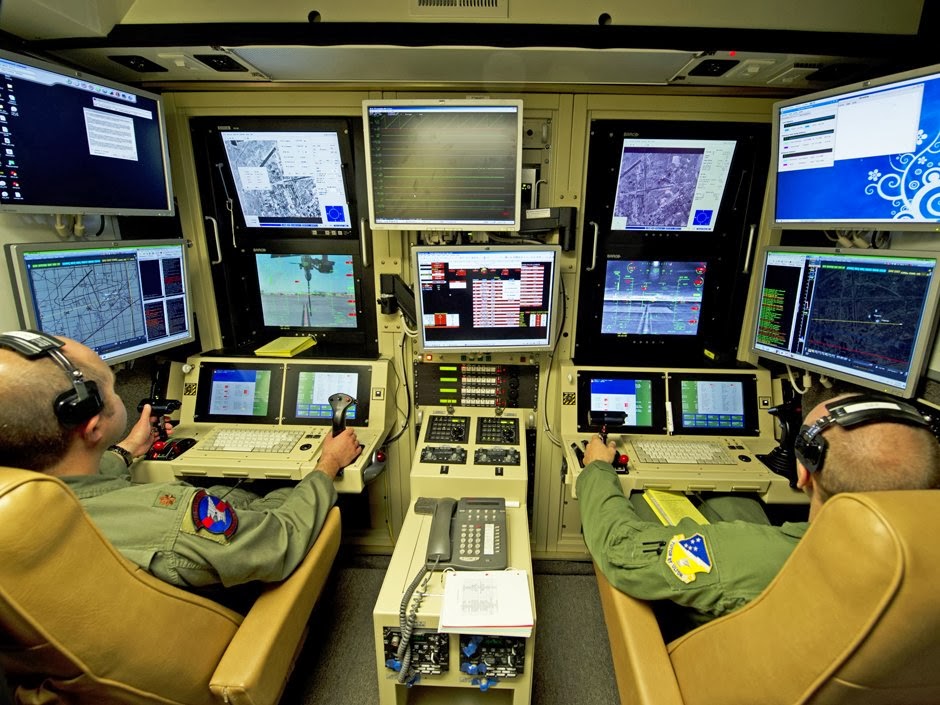
Drone ground station (USAF).
We don't know the U.S. count of civilian deaths The administration says that it has a count of civilian deaths, and that there is a "wide gap" between U.S. and independent figures. But the administration won't release its own figures. Outsideestimatesof total civilian deaths since 2002 range from just over 200 to more than 1,000. The Pakistani government has given three different numbers: 400, 147, and 67. McClatchy and the Washington Post obtained intelligence documents showing that for long stretches of time, the CIA estimated few or no civilian deaths. The documents also confirmed the use of signature strikes, in which the U.S. targets people without knowing their identity. The CIA categorized many of those killed as simply "other militants" or "foreign fighters." The Post wrote that the agency sometimes designated "militants" with what seemed like circumstantial or vague evidence, such as "men who were probably' involved in cross-border attacks" in Afghanistan.
RQ-1 Predator aircraft, Tallil Air Base, (AB), Iraq.
The administration reportedly curtailed signature strikes this year, though the new guidelines don't necessarily preclude them. A White House factsheet released around Obama's speech said that "it is not the case that all military-aged males in the vicinity of a target are deemed to be combatants." It did not say that people must be identified. (In any case, the U.S. has not officially acknowledged the policy of signature strikes.)
We don't know exactly who can be targeted The list of groups that the military considers "associated forces" of Al Qaeda is classified. The administration has declared that it targets members of Al Qaeda in the Arabian Peninsula, and "elements" of Al Shabaab, but there are still questions about how the U.S. determines that an individual belonging to those groups is in fact a "continuing and imminent threat." (After the terror alarm that led to the closing of U.S. embassies this summer, officials told the New York Times they had "expanded the scope of people [they] could go after" in Yemen.) This ties into the debate over civilian casualties: The government would seem to consider some people legitimate targets that others don't.
Amnesty International and Human Rights Watch conducted in-depth studies of particular strikes in Pakistan and Yemen, respectively. They include eyewitness reports of civilian deaths. (Most of the deaths investigated happened before the Obama administration's new policies were announced, although the administration has not said when those guidelines went into effect.) The reports also raised questions of the legality of specific strikes, questioning whether the deaths were all unavoidable casualties of legitimate attacks.It does not appear that the U.S. plans to expand strikes against Al Qaeda to other countries — officials have reportedly told Iraq, for example, it won't send drones there. But the U.S. has established a surveillance drone base in Niger, and fed information from drones to French forces fighting in Mali.
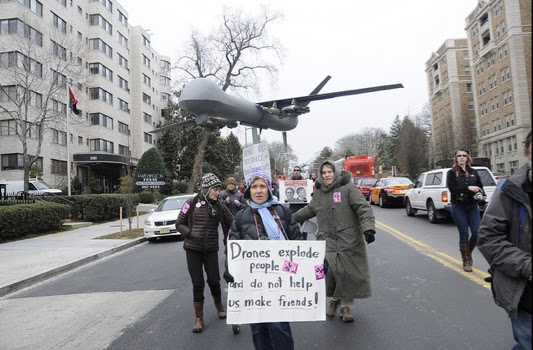
"Drones Kill People" - Protesters at President Obama's inauguration 2012 (Photo: Debra Sweet).
We don't know if the U.S. compensates civilian casualties CIA director John Brennan suggested during his confirmation hearing that the U.S. made condolence payments to harmed families. But there is little evidence of it happening. U.S. Central Command told ProPublica that it had 33 pages related to condolence payments — but wouldn't release any of them to us.
We don't always know which strikes are American While unnamed officials sometimes confirm that strikes came from U.S. drones, other attacks may be from Pakistani, Yemeni, or even Saudi planes. (It's also worth noting that the U.S. has also used cruise missiles and Special Forces raids. But the bulk of U.S. counterterrorism actions outside Afghanistan in recent years appear to rely on drones.)
We don't know the precise legal rationale behind the strikes Some members of Congress have seen the legal memos behind targeted killing of U.S. citizens. But lawmakers were not granted access to all memos on the program. Legislation pending in the Senate would require the administration to give the Intelligence Committees a list of such legal opinions. Other congressmen have introduced billswith more reporting requirements for targeted killings. (Proposals for a "drone court" for oversight have not gotten very far.)
"Reaper" Drone - Even deadlier than the Predator Drone.
It's far from clear that any of that additional oversight would lead to public disclosure. The government and the American Civil Liberties Union and the New York Times are still locked in court battles over requests for drone documents. While a judge has ruled the CIA can no longer assert the "fiction" that it can't reveal if it has any interest in drones, the agency hasn't been compelled to release any information yet. The government has also so far fought off disclosure of legal memos underpinning targeted killings.
And here are some things we've learned through leaks and independent reporting: How the U.S. tracks targets: Documents provided by Edward Snowden to the Washington Post detailed the NSA's "extensive involvement." Lawyers in a terrorism-related case also uncovered reports that government surveillance of their client may have led to a drone strike in Somalia. The Atlanticpublished a detailed account of Yemen using a child to plant a tracking chip on a man who was killed in a U.S. strike.
The CIA's role: The administration had reportedly planned to scale back the CIA's role in targeted killing, moving control of much of the drone program to the military. But the CIA reportedly still handles strikes in Pakistan and has a role in Yemen as well. Officials told Foreign Policy yesterday that the transition won't happen anytime soon.
The history of the programs: Revelations continue to change our understanding of the contours of the drone war, but two books published this year offer comprehensive accounts — The Way of the Knife, by Mark Mazzetti of the New York Times, and Dirty Wars, by Jeremy Scahill.


 French troops in Mali kill wanted jihadist's deputy (via AFP)