Global Perspectives Now Global Perspectives Now
Showing posts with label CIA. Show all posts

NSA Nightmare Scenario Comes True: Agency Planned To Use Spy Technology To Smear 'Radicalizers' - Logged Online 'Sex Activity'


Whistleblower Edward Snowden
Whistleblower Edward Snowden: Revelations from documents
leaked by the former NSA contractor continues to shock and
amaze. (Illustration: DonkeyHotey)
"It's exactly this kind of activity that has so many people concerned about the NSA. They're clearly not just spying on terrorist communications for the sake of preventing an attack. Now they're directly talking about using private information, like the fact that someone surfs porn or is 'attracted to fame' to do character assassinations of people they dislike."


NSA Spied On Porn Habits Of 'Radicalizers,' Planned To Use Details To Embarrass Them (via Techdirt)
The latest report on leaked Snowden docs from Glenn Greenwald (along with Ryan Gallagher and Ryan Grim at the Huffington Post) shows how the NSA had a plan to use the porn surfing habits of certain people they didn't like to discredit them. If this…


The Murder of JFK: WHO Did It? - Where New Evidence Points

Media specials are on tap for the 50th anniversary of John F. Kennedy’s murder, but none will explore the troubling new evidence that has been declassified in recent years – and that undercuts the Official Story of the Lone Gunman.
This essay examines the new evidence from several different vantage points: Why Oswald, Who was Oswald, the CIA Mystery, the FBI Mystery, Angleton's (CIA Director of Counter-Intelligence) Connection, the Autopsy Mystery, the Treatment of Senator Richard Russell, the Hesitant Investigators, the Medical Evidence, the FBI's Fiddling, and the ultimate Miscarriage of Justice.
In late 1991, film director Oliver Stone released JFK, his film about the investigation of the murder of President John F. Kennedy by New Orleans District Attorney Jim Garrison. To say the film was controversial does not begin to describe the furor which surrounded its reception. Six months before the film was in theaters, stories began to appear in large newspapers criticizing a film no one had seen yet.

When the film was finally shown, there was an interesting dichotomy. Whereas most of the film critics liked it, editorials and news stories about the movie attacked it. One critic actually lost her job over a positive review of the film.

But the film did two things relevant to the state of the evidence in the matter of President Kennedy’s assassination on Nov. 22, 1963. At the end of his film, Stone had shown a title card saying that the files of the House Select Committee on Assassinations (HSCA) had been classified until the year 2029.

Embarrassed – and faced with public outrage – Congress held hearings. Many people testified including Stone, and the last chief counsel of the HSCA, Robert Blakey. As a result, the Assassination Records Review Board (ARRB) was created, tasked with finding and releasing all documents held by public and private entities in America concerning the murder of President Kennedy. Eventually, two million pages of classified files were open to the public.

The former Texas School Book Depository Building in Dealey Plaza, Dallas
The former Texas School Book Depository
Building in Dealey Plaza, Dallas. Where
government conspiracy theorists claim
Oswald fired the shots that killed JFK.
(Photo: David Jones)
The second thing the film did was arouse the curiosity of many people who were not aware of the evidentiary problems that had haunted the Kennedy case for nearly 30 years. Stone’s film was the first time in over a decade that millions of Americans had been exposed to things like the Zapruder film, Oswald’s odd relationships with the FBI and CIA, his associations with right-wingers in Dallas and New Orleans, the investigative failings of the Warren Commission, the problems with the autopsy of President Kennedy, and much, much more.

These new people who were drawn into the case had fresh perspectives to offer and new insights. Between the newly declassified documents and this new generation of writers, the information base about both Kennedy and his murder grew exponentially in a relatively short time.

But this week’s 50th anniversary of President Kennedy’s assassination will be marked almost entirely by television specials that will be silent about this new and plentiful information, which alters the calculus of the Kennedy case. That is because, despite the uproar created by Stone’s film, the defenders of the Warren Commission’s narrative circled the wagons and protected the Establishment’s preferred solution to the assassination – that Lee Harvey Oswald acted alone.


Why Oswald?
There always was an attractiveness to the Oswald-did-it storyline. It is the simplest explanation, a lone gunman acting out of some personal grievance, ideological fixation or psychological imbalance. No need to explore evidence of a larger conspiracy. No need to integrate Kennedy’s murder into the historic developments that his presidency represented.

Thus, many influential people – from officials involved in the original investigation defending their judgments to a later generation of authors burnishing their reputations for probity – have fought fiercely to defend the Oswald-acted-alone narrative. They have done so despite nagging evidentiary problems, such as the “magic bullet theory,” which attributed the multiple wounds to Kennedy’s neck and Texas Gov. John Connally’s chest, wrist and thigh to a single bullet found almost unscathed on a gurney at Parkland Hospital, and those troubling images from the Zapruder film showing Kennedy’s head being knocked backward by the fatal shot, although Oswald was behind him at the Texas Bookstore Depository.

Most importantly, Gerald Posner’s book, Case Closed, which was published before the ARRB was even set up, was used to close the door on further inquiry by pronouncing Oswald guilty again. Yet, Posner’s book did not include any of the intriguing documents the ARRB declassified. Neither did it include the results of the ARRB special investigation into the medical evidence launched by chief counsel Jeremy Gunn.

After Posner’s book, there seemed to be something of an informal agreement by the gatekeepers in the media. There would be no programs dedicated to airing the discoveries of the ARRB, despite the fact that the ARRB had unprecedented powers to declassify documents and compel testimony. Because of these combination of factors, the American public was given little exposure to the ARRB material and the revolutionary work of new authors on the Kennedy case, the most infamous American homicide of the Twentieth Century.

Besides the Oswald-acted-alone solution, there have been other proposed narratives that accept the idea of conspiracy but don’t directly challenge the institutions of the state. These scenarios acknowledge the likelihood of other conspirators but point the finger at the Mafia or Fidel Castro or some other enemies of America.

But much of the new evidence tends to bolster the narrative advanced by Garrison and by Stone’s movie: that the assassination must have involved elements of the U.S. intelligence community working with right-wing operatives who considered Kennedy soft on communism and that a cover-up was put in place by key government figures to prevent an unraveling of these powerful institutions and the erosion of public trust in the authorities.

Who Was Oswald?
Let us begin with the figure of Lee Harvey Oswald. Oswald had been portrayed by the Warren Commission as a lonely, communist sociopath. Although there was never any clear motive put forth by the Warren Commission as to why the alleged assassin killed JFK, it was intimated that it was the net result of the frustrations in his life caused by financial problems, ideological intent, and marital troubles. This is still what most current defenders of the Commission say today.

But one of the most surprising things that the ARRB disclosed was the volume of files on Oswald held by both the CIA and FBI – after both agencies had long denied that they had much paper on Oswald. But it was not just the volume of documents, but it was the unexpected direction they pointed.

Daley Plaza, Dallas, TX.
Dealey Plaza: Where the deed was done. (Photo: David Jones)
One of the most curious aspects of Oswald’s strange and contradictory life was his military service. One of the things that shocked New Orleans DA Jim Garrison was the fact that, while in the Marines, Oswald took a Russian test. As Garrison writes in his book, the Commission tried to explain this away by stating that he got more questions wrong than right.

But it’s obvious that Oswald stuck with learning Russian because when a friend of his arranged a meeting with Rosaleen Quinn, she commented afterwards that Oswald spoke excellent Russian. And Quinn had been privately tutored in advance of a State Department exam. (James DiEugenio, Destiny Betrayed, Second Edition, p. 131)

After acquiring fluency in Russian, Oswald then applied for a hardship discharge in order to leave the service early. Even though he had just a few months left to serve, his request was granted – and in only 10 days. The HSCA interviewed a person on the board who granted the discharge. Colonel B. J. Kozak testified that it normally took from three to six months to secure such a release. (HSCA interview of Kozak of Aug. 2, 1978)

After Oswald returned from Russia – receiving surprisingly little trouble despite his defection – he became friendly with the White Russian community in the Dallas/Fort Worth area. He then went to New Orleans in the summer of 1963. Numerous witnesses had testified to seeing him with former FBI agent Guy Banister or at Banister’s office at 544 Camp Street.

But in the files declassified by the ARRB there is even more evidence in this regard. In the declassified files of the Church Committee, there is testimony by two federal immigration agents that they were following David Ferrie in 1963 because of his association with Cubans in the country illegally. Wendell Roache and Ron Smith of the Immigration and Naturalization Service stated that they traced Ferrie to Banister’s office at 544 Camp Street, and Oswald was there. (DiEugenio, p. 113)

Further, at least one of the pro-Castro flyers that Oswald was passing out that summer was stamped with the 544 Camp Street address. According to Banister’s secretary Delphine Roberts, Banister was aware that Oswald had committed this faux pas, and he was upset about it. The rightwing zealot complained that, “How is it going to look for him to have the same address as me!” (HSCA interview with Roberts, July 6, 1978)

The natural question arises: What would an alleged communist like Oswald be doing using the conservative Banister’s office as an address, and also working out of that office? In that regard, one of the most compelling revelations to emerge from the ARRB is that both the FBI and the CIA were running counter-intelligence operations against the Fair Play for Cuba Committee (FPCC) in 1963. This included using electronic surveillance, penetration agents, and agents provocateur against the New York-based organization.

CIA Mystery 
In one of the CIA’s declassified files on this subject, it was discovered that the men running this counter-intelligence effort at CIA were David Phillips and Jim McCord. (Newman, pgs. 236-41) Phillips’s name in this regard is especially fascinating because of his reported meeting with Oswald in August of 1963 at the Southland Center in Dallas by the militant Cuban exile Antonio Veciana.

At that time, according to the Warren Commission, Oswald was about a month away from leaving for Mexico. In addition to not telling the reader about Phillips, McCord and the CIA counter-intelligence program against the FPCC, the Warren Report also did not reveal a memorandum sent from the CIA to the FBI on Sept. 16, 1963, saying the CIA was “giving some consideration to countering the activities” of the FPCC “in foreign countries. … CIA is also giving some thought to planting deceptive information which might embarrass the Committee in areas where it does have some support.”

Oswald had just embarrassed the FPCC by his tactics in New Orleans. First, by getting into a fight with an anti-Castro activist, being arrested, jailed, and then pleading guilty in court. He then took part in a debate where he was exposed as a former Soviet defector. As author Jim Douglass asks: Did this memo refer to Oswald now going to Mexico? (Douglass, JFK and the Unspeakable, p. 179)

John F Kennedy Statue
John F Kennedy Statue. (Photo: Martin Belam)
One of the notable achievements of the ARRB was the fact that it declassified the HSCA’s Mexico City Report, which clearly suggests that there was an imposter masquerading as Oswald at both the Cuban consulate and Russian embassy, the places where Oswald was supposed to have visited while he was supposed to be there.

The report states that the CIA could produce no pictures of Oswald either entering or leaving either place, although the Agency had multiple cameras facing each doorway. Further, there is a table in the report which shows that the surveillance tapes the Agency says it had of Oswald in both places could not be of Oswald because the man the CIA had on the tapes spoke broken Russian and fluent Spanish. (Lopez Report, p. 130) However, witnesses said Oswald spoke fluent Russian and broken Spanish.

When one of the tapes of Oswald was sent to Dallas after Kennedy’s assassination and listened to by the FBI agents interviewing Oswald, the agents said the voice was not Oswald’s. When FBI Director J. Edgar Hoover was alerted to this, he relayed the information to President Johnson. (FBI Memorandum from Hoover to James Rowley, Nov. 23, 1963)

The FBI Mystery
There are two more declassified connections by the FBI to this important episode. First, a FLASH warning that the FBI had put on Oswald’s file, after his defection to the Soviet Union, was taken off while Oswald was in Mexico. Further, it was removed at about the time the Bureau got information that Oswald was allegedly meeting a KGB agent named Valery Kostikov.

This is important, because as both authors John Newman and Jim Douglass note, if the FLASH notice had been in place, it is probable that Oswald would have been placed on the Security Index. That list would have been turned over to the Secret Service, and Oswald would likely have been picked up or surveilled for Kennedy’s upcoming trip to Dallas.

Secondly, in a declassified memo discovered by Newman, Hoover had scribbled a handwritten note in the marginalia of a memo. In speaking of cooperation between the CIA and the FBI, the Director wrote that he was doubtful about such endeavors because he could not forget “the false story re Oswald’s trip to Mexico” as an example of their double-dealing. Within six weeks of Kennedy’s murder, Hoover thought that the CIA was, at the very least, not being forthcoming about Oswald’s activities in Mexico City.

Hoover was not alone in this suspicion about a CIA connection to Oswald. At a talk at the Cyril Wecht Symposium in Pittsburgh last month, Dan Hardway, an HSCA investigator who specialized on exploring a possible relationship between Oswald and the CIA, said the House panel prepared two indictments for perjury based on the obstruction of the Mexico City investigation. One was for Phillips; the other was for Anne Goodpasture, who controlled the tape and photo production in Mexico City.

Hardway has revealed that when he and another HSCA investigator were getting very close to exposing the skullduggery in Mexico City and who was responsible for it, the CIA moved a man name George Johannides into position as a liaison man over them.

As journalist Jefferson Morley has revealed, the CIA lied to Robert Blakey about the appointment of Johannides. The Agency told Blakely that his new liaison had no connection to the Kennedy case, when, in 1963, Johannides was the Chief of the Psychological Warfare Branch at JM/WAVE, the CIA’s huge Miami station. One of his specific functions was to monitor and supply the anti-Castro Cuban exile group, Cuban Student Directorate, or DRE, which was in contact with Oswald that summer. Carlos Bringuier, the man who got into a physical altercation with Oswald on a city street in New Orleans, was a member of the local branch of the DRE.

Angleton’s Connection
A similar maneuver occurred during the Warren Commission investigation, when the original CIA liaison to the Warren Commission, John Whitten, was replaced by James Angleton, the CIA’s counter-intelligence chief whose office handled (or mishandled) the original reporting about Oswald’s defection to the Soviet Union.

When reports came in about Oswald entering the American embassy in Moscow and asking to renounce his citizenship, the information went to the various intelligence repositories in Washington. The FBI issued a FLASH warning to be placed on Oswald if he tried to reenter the country under a false name. After all, the possibility existed that the KGB could have turned him into a spy.

However, at the CIA, the information about Oswald was not acted on immediately or with the normal protocol. A routine 201 form, which catalogues anyone of interest to the Agency, was not filled out on Oswald at that time. Nor did the information go to the Soviet Russia division. Instead, the Oswald notice was funneled to James Angleton’s super-secret, CI/SIG unit, a protective agency that was supposed to be on guard against penetration agents but has been connected to some of the CIA’s most convoluted deep-cover operations, sometimes called “the wilderness of mirrors.” (John Newman, Oswald and the CIA, p. 27)

Besides Angleton’s influence over what CIA files would be made available to the Warren Commission, one of its seven members was former CIA Director Allen Dulles, whom President Kennedy had replaced as director after the Bay of Pigs fiasco in 1961.

So, it is clear today that the idea the CIA had no intelligence interest in Oswald in the months leading up to Kennedy’s murder has been disproven. In fact, Newman uncovered a CIA memo in the Soviet Russia division which reads, “It was partly out of curiosity to learn if Oswald’s wife would actually accompany him to our country, partly out of interest in Oswald’s own experiences in the USSR, that we showed operational intelligence interest in the Harvey [Oswald] Story.”

The Autopsy Mystery
Another one of the myths circulated by the Warren Commission was that they did not have the actual autopsy exhibits because the Kennedy family would not allow them to access the material. This was a pretense exposed by the declassification of the Commission’s Jan. 21, 1964 executive session hearing. In that transcript, Commissioner John McCloy asked Chief Counsel Lee Rankin if they had the raw materials of the autopsy, and Rankin replied that they did.

In a transcript from the next session on Jan. 27, Rankin talked about actually seeing an autopsy picture and wondering how the bullet could exit Kennedy’s throat from an entrance point that low in the back. Rankin’s puzzlement about the back wound segues neatly into one piece of information that the ARRB did manage to get into the mainstream U.S. media, namely that Commissioner Gerald Ford changed the draft of the Warren Report to move the location of this back wound that so puzzled Rankin up into Kennedy’s neck.

This all too revealing alteration was exposed when Rankin’s son donated an earlier draft of the Warren Report to the ARRB. As Commission historian Gerald McKnight notes in his book Breach of Trust, this revision brought the back wound into “line with the Commission’s no-conspiracy conclusion, repositioning it to make it consistent with what came to be called, the single-bullet theory.” (McKnight, pgs. 171-172)

With the knowledge today that the Commission secretly did have the autopsy photos, this act seems even worse. Because, later on, when the photos were finally revealed to the public, it is clear that the wound was in the back, and not in Kennedy’s neck. Ford appears to have done this simply to make the Commission’s official verdict more palatable to the public, because if the shot was fired from over 60 feet up, from the sixth floor of the Texas School Book Depository, how could the bullet hit Kennedy in the back and exit at a higher point if it only went through soft tissue?

We now know that this questionable proposition was not even credible inside the Commission itself. The Commission was presented with evidence of three shells being recovered from the so-called sniper’s nest on the sixth floor of the Texas School Book Depository. So, to make Oswald the lone assassin, only three bullets had to be responsible for all the wounds to all the victims in Dealey Plaza.

The Commission said bystander James Tague, standing on Commerce Street, was hit by a missed shot, and one shot fatally wounded Kennedy by striking him in the head. Which left one shot to do the rest of the damage. And it was quite a lot of damage: seven wounds and two smashed bones in Kennedy and Governor Connally who was sitting in the limousine in front of the President. Those seven wounds with one shot represent the trajectory of what has come to be known as the Magic Bullet.

Rolling Russell 
When the Warren Commission verdict was formally announced in the fall of 1964, one of the reasons it appeared authoritative was that it was presented as being unanimous. Seven storied public figures had agreed on each and every aspect of the case against Oswald. Today we know that this was not true.

The best evidence demonstrating its falsity is the Commission’s treatment of Sen. Richard Russell, D-Georgia. For a master’s thesis produced under McKnight’s guidance in 2002, Dani E. Biancolli went through the Russell archive at the University of Georgia.

Almost from the beginning, Russell had problems with the way the Commission was doing business. For instance, Russell was puzzled that the FBI report did not allow for the single-bullet theory. It stated that two separate shots hit Kennedy and one hit Connally. If that is not confusing enough, when the CIA analyzed the Zapruder film, they decided there were two assassins. (McKnight, p. 6)

Russell was not satisfied by the hastily assembled FBI report. He also objected to the fact that Hoover was leaking its findings to the press, making it difficult for the Commission to maintain its independence in the face of public perceptions. Being an experienced trial lawyer, he also began to notice that the Commission was not notifying him when important witnesses would be testifying, e.g. Oswald’s brother, Robert. (Biancolli, p. 46)

Russell also noted that the CIA was giving certain members of the Commission more information than others. Troubled by the overall proceedings, Russell wrote a memo to himself which began with the phrase, “Something strange is happening.” He then noted that the Commission was only going to consider Oswald as the assassin. To lawyer Russell, this was “an untenable position.” (ibid, p. 47) Russell was so disturbed by the way the Commission was progressing that he actually composed a letter of resignation to President Lyndon Johnson.

Russell took the step of drafting an official dissent to the Warren Report. And he wanted the report to contain his reservations about the Magic Bullet. (ibid, p. 63) Aware of this, the more active members of the Commission – Gerald Ford, Allen Dulles, John McCloy and chief counsel Lee Rankin – tricked Russell. They had discontinued their dealings with their stenography service prior to the final meeting where Russell was to present his dissent. But they did have a secretary in the room to create the pretense that a full transcript was being recorded. (ibid, p. 65) No such thing occurred.

Russell was so effective in his presentation at this meeting that he was joined in the effort by Sen. John Sherman Cooper, R-Kentucky, and to a lesser extent by Rep. Hale Boggs, D-Louisiana. But Russell’s eloquent dissent was not recorded in the transcript. In fact, there really is no transcript of this Sept. 18, 1964 meeting. (ibid, pgs. 63-64) With no transcript available, none of Russell’s objections made it into the Warren Report. Thus, the false veneer of a unanimous Commission was maintained.

John F. Kennedy Memorial, Arlington National Cemetery
John F. Kennedy Memorial, Arlington National Cemetery.
(Photo: Bernt Rostad)

Further showing how compromised the Warren Commission was, it is clear today that the Commission demanded little respect from the intelligence agencies supplying it with information. For instance, as ARRB employee Doug Horne discovered, Commission counsel Arlen Specter requested the Secret Service produce any tapes of the Nov. 22 press conference by the doctors at Parkland Hospital. Even though they had a recording, the Secret Service failed to turn it over to the Commission. Perhaps because during the interview, Dr. Malcolm Perry said three times that the wound to Kennedy’s throat was one of entrance. If that were true, Oswald could not have caused it. 

The CIA also sent the Commission very limited information about Oswald’s alleged trip to Mexico City. For instance, the CIA did not send any information to the Commission about any of the phone taps they had at the Cuban or Russian embassies. And there is no evidence that the Commission ever knew who did the translation for the intercepts of incoming phone calls.

Further, the Commission never interviewed Silvia Duran, the receptionist at the Cuban consulate, the person who had the most contact with Oswald. Because of these failings, the information in the Warren Report about Oswald in Mexico City, which many people today see as crucial, is so skimpy as to be almost useless.

Hesitant Investigators
As the Russell incident indicates, it’s clear today that the Warren Commission was a reluctant investigative body from the start. This began with the technique President Johnson used to get Earl Warren to serve as chairman, something Warren did not want to do. LBJ told Warren that because of Oswald’s visits to the Russian and Cuban consulates, there was a danger of nuclear confrontation with the Soviet Union and Cuba and the possible deaths of 40 million Americans in a matter of minutes.

Johnson later said Warren teared up at this suggestion, and Warren mentioned Johnson’s warning at his first staff meeting. The danger of a freewheeling investigation clearly had an impact on many of the investigators who came to see their job as tamping down suspicions of a larger conspiracy, rather than following the facts wherever they might lead. When Wesley Liebeler met with witness Sylvia Odio in Dallas, he told her that they had orders from Warren that if they came across any evidence of conspiracy they were to shove it under the rug. (Odio interview with Church Committee, Jan. 16, 1976)

What makes this so regrettable today is that there is no audio or photographic evidence that Oswald was at either the Russian or Cuban offices in Mexico City. The descriptions of a short, blonde man suggest an imposter. Hoover also felt that the CIA had given him a cover story. This declassified evidence in the Lopez Report leaves the question: Was the specter of a nuclear war used as a pretext to stop any real investigation?

Another crucial piece of evidence that was revived by the ARRB was this: There appears to have been an unsuccessful attempt to kill Kennedy in Chicago just three weeks before the successful one in Dallas. In November 1975, journalist Edwin Black wrote a long and detailed essay on this aborted plot for the Chicago Independent, a paper with a small and local circulation. Soon, this milestone essay was more or less forgotten, but the HSCA secured a copy of it.

Because of its recirculation, other writers have done more work on the subject.  One of the most disturbing aspects of the Chicago attempt is that the outline of the plot is eerily similar to what happened in Dallas, down to the apparent fall guy. Three men who appeared to be Cubans were going to kill Kennedy in a rifle ambush as he exited off a freeway ramp in front of a tall building.

The man who was supposed to be accused of the crime was Thomas Vallee. Like Oswald, Valle was a former Marine who was stationed at a U-2 base in Japan. Vallee supposedly was resentful toward Kennedy because of the Bay of Pigs disaster. Curiously, the codename of the FBI informant who tipped off the Secret Service was “Lee.” The existence of a prior assassination plot with parallels to Kennedy’s killing in Dallas would seem to be relevant if one were exploring a wider conspiracy, but there was not one word about this episode in the Warren Report.

Medical Evidence
Some of the most startling new evidence in the JFK case from the declassified files relates to the ARRB’s medical investigation and from new doctors who have entered the JFK field. For instance, Dr. Gary Aguilar has collated the interviews done by HSCA investigators Andy Purdy and Mark Flanagan about the wounds to President Kennedy as seen by the witnesses at Bethesda Medical Center, the hospital where Kennedy’s autopsy was done after his body was returned to Washington.

The HSCA report said there was a discrepancy between what the medical staffers at Parkland Hospital in Dallas saw and what the staffers at Bethesda saw. Witnesses at the former, where Kennedy was rushed after the shooting, said they saw a large, avulsive hole in the rear of Kennedy’s skull. This would strongly indicate a shot from the front. Yet the HSCA Report said that the witnesses at Bethesda did not see this wound.

It turns out this was false. When Aguilar went through all the declassified reports from the Bethesda witnesses, they agreed that there was a large avulsive hole in the rear of Kennedy’s skull. Aguilar has a table of over 40 witnesses in two locations who are now on the record as saying they saw this wound. The odds of that many trained medical personnel being wrong are, needless to say, very high. Yet, it remains unclear who at the HSCA was responsible for the deception.

As contradictory to the single-gunman theory as the ARRB-revealed medical evidence seems to be, the present state of the ballistics evidence is probably moreso. Broadly speaking, this consists of the ammunition, the rifle, and the crime scene.

Let us begin with new revelations about the so-called Magic Bullet. When Gary Aguilar was going through the declassified FBI files pertaining to the identification of that exhibit – formally called CE 399 – he was puzzled by the lack of actual FBI field reports in the file, so-called “302” reports on witness interviews.

What initially spurred his interest in this matter was the 1967 interview that author Josiah Thompson conducted with O. P. Wright, the security director at Parkland Hospital. When Thompson showed Wright a photo of CE 399, he denied that it was the bullet he gave to the Secret Service. CE 399 is a round-nosed, military jacketed, copper-coated bullet. Wright said he turned over a lead-colored, sharp-nosed, hunting round. (Thompson, Six Seconds in Dallas, p. 175)

Yet, in the declassified file, Aguilar could find no 302 where anything like Wright’s definitive response to Thompson was recorded. Or a 302 in which Wright said that CE 399 resembled the bullet he found the day of the assassination. Yet, the FBI was supposed to have shown CE 399 to Wright to confirm the identification of the Magic Bullet as what was turned over at Parkland Hospital. But there was only a summary memorandum confirming that ID.

Though the ARRB told Aguilar that they had exhausted that particular FBI file, there was a clue for further inquiry. In the summary memo, the FBI agent who supposedly showed the exhibit to Wright was identified as Bardwell Odum. In November 2001, Aguilar and Thompson visited the retired agent who told his interviewers that he never took any bullet around to show to any Parkland witnesses – and since he knew Wright well, he would have recalled the interview.

Further, if that event had happened, Odum would have had to file a 302. Aguilar had studied the report file in sequential order and none were missing, indicating that Odum never filed a 302 presumably because he never showed the bullet to Wright.

The FBI’s Fiddling
But why would the FBI have fiddled with the evidence relating to the chain of custody for the Magic Bullet? One obvious answer would be that FBI Director Hoover understood how important it was to remove any doubts that Oswald was the lone gunman.

After the declassification process was complete, researcher John Hunt petitioned the National Archives to examine the FBI’s own data in order to determine if CE 399 actually arrived at FBI headquarters when the Bureau said it did and if it was carried there by agent Elmer Lee Todd as Hoover said it was. As basic to an investigation as trail of evidence is, this was not done by either the Warren Commission or the HSCA.

In a handwritten receipt, Todd noted he got the bullet at the White House from James Rowley of the Secret Service at 8:50 p.m. Hunt then reviewed the work of Robert Frazier who was the technician who booked and analyzed firearms evidence on the JFK case that day. In Frazier’s chronicle, entitled appropriately enough, “History of Evidence,” Frazier wrote that he received the bullet from Todd at 7:30 p.m. In another document entitled “Laboratory Work Sheet,” Frazier wrote this again and described the exhibit as “Bullet from Stretcher.”

The obvious problem was: How could Todd have given CE 399 to Frazier at the FBI lab before he got it from Rowley at the White House? Assuming the contemporaneous documentary record is correct, either the FBI switched the bullet or there was more than one bullet. Either alternative would vitiate the Commission’s conclusion about Oswald as the lone gunman.

In Thompson’s book he writes that both Todd and Frazier marked the bullet with their initials; this was based on a two-page FBI document inside a Justice Department Report. The FBI needed Todd’s initials on the bullet because the initials of the man who gave the bullet to Rowley, Secret Service agent Richard Johnsen, are not on CE 399. And neither are Rowley’s. Todd’s initials had to be there to give the chain of possession any validity at all.

Hunt discovered that Todd’s initials are not on CE 399, which would mean that the forensic value of the Magic Bullet was worthless. (Hunt’s articles can be read herehttp://www.jfklancer.com/hunt/mystery.html, and herehttp://www.jfklancer.com/hunt/phantom.htm).

Miscarriage of Justice
This essay could be twice as long as it is. And it could touch on many other different fields: the efforts of the FBI and CIA to electronically monitor Jim Garrison’s office; the FBI concealment of Guy Banister’s address of 544 Camp Street from the Warren Commission; the witnesses who saw Oswald, Clay Shaw and David Ferrie in the hamlets of Clinton and Jackson; the testimony of Victoria Adams that Oswald was not running down the Depository stairs from the sixth floor after the shooting; the work by Josiah Thompson and Dave Wimp which demonstrates there is no forward movement by Kennedy at frames 312-313 of the Zapruder film, which shows Kennedy going only one way, back and to the left.

These revelations, based largely on the documentary record released by the ARRB, have revolutionized what the evidence tells us about Kennedy’s assassination. Based on these documents and other discoveries, the Warren Commission is revealed as a miscarriage of justice and its report a distortion of history, perhaps justified in the minds of some participants as needed to protect the country from the repercussions of a no-holds-barred investigation.

While President Johnson may have raised the specter of a nuclear conflagration in 1963, the later motives for the continuing cover-up – and the intensity of the attacks on anyone who has questioned the official version – can best be explained by the institutional self-interests of the government agencies that would be implicated in the cover-up or the actual crime.

Along with fierce resistance from the CIA and the FBI, there was the close-minded response to the new evidence from the gatekeepers of the major U.S. news media. Ridiculing authors and investigators who challenged the Warren Commission’s findings became something of a litmus test for measuring a journalist’s fitness to get a good-paying job in the mainstream press.

But this arrogant behavior by these powerful governmental and media institutions – their contempt for an intellectually unconstrained evaluation of the JFK evidence – has proved costly in terms of public trust. Polls reveal that the decline in America’s faith in government began in 1964, the year the Warren Report was issued. As the ARRB’s former counsel Jeremy Gunn said in a speech at Stanford, with what the ARRB discovered, he would much rather be defending Oswald than prosecuting him.

Despite this new evidence, there are many programs being broadcast this month about both President Kennedy and his murder, e.g. Bill O’Reilly’s Killing Kennedy. Not a single one will present anywhere near a representative selection of the new evidentiary discoveries made by the ARRB. Yet, this information is crucial to understanding where the United States finds itself today, a country awash in excessive secrecy and growing public distrust.

Another one of the declassified files – the records of the Sec/Def meeting of May 1963 – revealed that Oliver Stone was correct in another facet of his movie. President Kennedy was planning to withdraw from Vietnam, a decision that – if not reversed by President Johnson – might have dramatically changed the course of U.S. history.

In the face of this continuing denial of a full accounting of Kennedy’s assassination on the 50thanniversary, the public should ask two simple questions: What really happened to President Kennedy in Dealey Plaza? And why the unending resistance from the news media to present the new evidence to the American people?

_______
Jim DiEugenio is a researcher and writer on the assassination of President John F. Kennedy and other mysteries of that era. His most recent book is Reclaiming Parkland.
Copyright © Jim DiEugenio, Consortiumnews, 2013 


Reprinted with permission from Center for Research in Globalization.

Pakistan: Dr. Who Helped CIA Find Bin Laden Charged With Murder of Patient 8 Yrs Ago - He Was Already Serving 33-Yr Sentence

The doctor, Shakil Afridi, was hailed as a hero by American officials but was given a 33-year sentence. He was convicted and jailed on charges of being a member of a terrorist organization. Pakistan also accused Afridi's of running a fake vaccination campaign for the CIA to gather DNA evidence to confirm the presence of bin Laden. Local vaccination programs have been hampered in Pakistan ever since because of suspicions raised by the bin Laden operation. Currently, Alfidi is being charged with the death of a patient eight years ago.
The video will take a few moments to load.

Doctor Who Helped U.S. Find Bin Laden Charged With Murder (via Repost Video News)
The doctor who helped the CIA track down Osama bin Laden during a secret raid in 2011 has been charged with murder.


JFK Cover-Up: Where There's Smoke There's Fire

Elaborate cover-ups spanning 50 years cannot orchestrate themselves, and there must be compelling reasons for hiding the truth from the American people, or else it would simply be declassified and revealed.


Frame from Zapruder film.
A frame from the famous Zapruder film clearly shows JFK taking a shot from
the front, while corporate media continues to insist the bullet came from be-
hind and was fired by 'lone gunman' Lee Harvey Oswald.

By Joe Giambrone
In November of 2003, Senator Max Cleland resigned from the 9/11 Commission investigation, directly disparaging it by way of the Warren Commissioninvestigation.  Senator Cleland said:
[T]he Warren Commission blew it. I'm not going to be part of that. I'm not going to be part of looking at information only partially. I'm not going to be part of just coming to quick conclusions. I'm not going to be part of political pressure to do this or not do that ( Boehlert ).
The most obvious fact, to indicate that the true story of John F. Kennedy's slaying is not as the government has presented, is the cover-up itself.  Elaborate cover-ups spanning 50 years cannot orchestrate themselves, and there must be compelling reasons for hiding the truth from the American people, or else it would simply be declassified and revealed.  If the killing of the president was committed by a lone nut single shooter named Lee Harvey Oswald, because of his great love of Marxism, there would be no compelling reason to keep his files secret five decades after the fact.  Quite the opposite, Mr. Oswald's clear guilt and personal history would have been useful propaganda material in the ideological battle between the Western world and the Soviet bloc.  The ongoing and arguably illegal suppression of assassination evidence by the US government should be taken as a clear indicator of some level of official complicity in the original assassination.

READ MORE...

The U.S. Secret State and the Internet: “Dirty Secrets” and “Crypto Wars” from “Clipper Chip” and ECHELON to PRISM

Back in the 1990s, security researchers and privacy watchdogs were alarmed by government demands that hardware and software firms build “backdoors” into their products, the millions of personal computers and cell phones propelling communication flows along the now-quaint “information superhighway.”
London in 1984, as described by Novelist George Orwell
London in 1984, as described by Novelist George Orwell. (Illustration: Anton Raath)


By Tom Burghardt
Global Research, November 10, 2013
Never mind that the same factory-installed kit that allowed secret state agencies to troll through private communications also served as a discrete portal for criminal gangs to loot your bank account or steal your identity.

To make matters worse, instead of the accountability promised the American people by Congress in the wake of the Watergate scandal, successive US administrations have worked assiduously to erect an impenetrable secrecy regime backstopped by secret laws overseen by secret courts which operate on the basis of secret administrative subpoenas, latter day lettres de cachet.

But now that all their dirty secrets are popping out of Edward Snowden’s “bottomless briefcase,” we also know the “Crypto Wars” of the 1990s never ended.

Documents published by The Guardian and The New York Times revealed that the National Security Agency “actively engages the US and IT industries” and has “broadly compromised the guarantees that internet companies have given consumers to reassure them that their communications, online banking and medical records would be indecipherable to criminals or governments.”
“Those methods include covert measures to ensure NSA control over setting of international encryption standards,” The Guardian disclosed, along with “the use of supercomputers to break encryption with ‘brute force’, and–the most closely guarded secret of all–collaboration with technology companies and internet service providers themselves.”
According to The New York Times, NSA “had found ways inside some of the encryption chips that scramble information for businesses and governments, either by working with chipmakers to insert back doors or by surreptitiously exploiting existing security flaws, according to the documents.”

In fact, “vulnerabilities” inserted “into commercial encryption systems” would be known to NSA alone. Everyone else, including commercial customers, are referred to in the documents as “adversaries.”

The cover name for this program is Project BULLRUN. An agency classification guide asserts that “Project BULLRUN deals with NSA’s abilities to defeat the encryption used in specific network communication technologies. BULLRUN involves multiple sources, all of which are extremely sensitive. They include CNE [computer network exploitation], interdiction, industry relationships, collaboration with other IC entities, and advanced mathematical techniques.”

In furtherance of those goals, the agency created a “Commercial Solutions Center (NCSC) to leverage sensitive, cooperative relationships with industry partners” that will “further NSA/CSS capabilities against encryption used in network communications technologies,” and already “has some capabilities against the encryption used in TLS/SSL. HTTPS, SSH, VPNs, VoIP, WEBMAIL, and other network communications technologies.”

Time and again, beginning in the 1970s with the publication of perhaps the earliest NSA exposé by Ramparts Magazine, we learned that when agency schemes came to light, if they couldn’t convince they resorted to threats, bribery or the outright subversion of the standard setting process itself, which destroyed trust and rendered all our electronic interactions far less safe.

Tunneling underground, NSA, telcos and corporate tech giants worked hand-in-glove to sabotage what could have been a free and open system of global communications, creating instead the Frankenstein monster which AT&T whistleblower Mark Klein denounced as a “Big Brother machine.”

The Secret State and the Internet
Five years after British engineer Tim Berners-Lee, Belgian computer scientist Robert Cailliau and their team at CERN developed a system for assembling, and sharing, hypertext documents via the internet, which they dubbed the World Wide Web, in 1994 the Clinton administration announced it would compel software and hardware developers to install what came to known as the “Clipper Chip” into their products.

The veritable explosion of networked communication systems spawned by the mass marketing of easy-to-use personal computers equipped with newly-invented internet browsers, set off a panic amongst political elites.

How to control these seemingly anarchic information flows operating outside “normal” channels?
In theory at least, those doing the communicating–academics, dissidents, journalists, economic rivals, even other spies, hackers or “terrorists” (a fungible term generally meaning outsider groups not on board with America’s imperial goals)–were the least amenable users of the new technology and would not look kindly on state efforts to corral them.

As new communication systems spread like wildfire, especially among the great unwashed mass of “little people,” so too came a stream of dire pronouncements that the internet was now a “critical national asset” which required close attention and guidance.

President Clinton’s Commission on Critical Infrastructure Protection released a report that called for a vast increase in funding to protect US infrastructure along with one of the first of many “cyberwar” tropes that would come to dominate the media landscape.

“In the cyber dimension,” the report breathlessly averred, “there are no boundaries. Our infrastructures are exposed to new vulnerabilities–cyber vulnerabilities–and new threats–cyber threats. And perhaps most difficult of all, the defenses that served us so well in the past offer little protection from the cyber threat. Our infrastructures can now be struck directly by a variety of malicious tools.”

And when a commercial market for cheap, accessible encryption software was added to the mix, security mandarins at Ft. Meade and Cheltenham realized the genie would soon be out of the bottle.
After all they reasoned, NSA and GCHQ were the undisputed masters of military-grade cryptography who had cracked secret Soviet codes which helped “win” the Cold War. Were they to be out maneuvered by some geeks in a garage who did not share or were perhaps even hostile to the “post-communist” triumphalism which had decreed America was now the world’s “indispensable nation”?
Technological advances were leveling the playing field, creating new democratic space in the realm of knowledge creation accessible to everyone; a new mode for communicating which threatened to bypass entrenched power centers, especially in government and media circles accustomed to a monopoly over the Official Story.

US spies faced a dilemma. The same technology which created a new business model worth hundreds of billions of dollars for US tech corporations also offered the public and pesky political outliers across the political spectrum, the means to do the same.

How to stay ahead of the curve? Why not control the tempo of product development by crafting regulations, along with steep penalties for noncompliance, that all communications be accessible to our guardians, strictly for “law enforcement” purposes mind you, by including backdoors into commercially available encryption products.

Total Information Awareness 1.0
Who to turn to? Certainly such hush-hush work needed to be in safe hands.
The Clinton administration, in keeping with their goal to “reinvent government” by privatizing everything, turned to Mykotronx, Inc., a California-based company founded in 1983 by former NSA engineers, Robert E. Gottfried and Kikuo Ogawa, mining gold in the emerging information security market.

Indeed, one of the firm’s top players was Ralph O’Connell, was described in a 1993 document published by Computer Professionals for Social Responsibility (CPSR) as “the father of COMSEC” and the “Principle NSA Technical Contact” on Clipper and related cryptography projects.

A 1993 Business Wire release quoted the firm’s president, Leonard J. Baker, as saying that Clipper was “a good example of the transfer of military technology to the commercial and general government fields with handsome cost benefits. This technology should now pay big dividends to US taxpayers.”

It would certainly pay “big dividends” to Mykotronx’s owners.

Acquired by Rainbow Technologies in 1995, and eventually by Military-Industrial-Surveillance Complex powerhouse Raytheon in 2012, at the time the Los Angeles Times reported that “Mykotronx had been privately held, and its owners will receive 1.82 million shares of Rainbow stock–making the deal worth $37.9 million.”

The Clipper chip was touted by the administration as a simple device that would protect the private communications of users while also allowing government agents to obtain the keys that unlocked those communications, an early manifestation of what has since become know as law enforcement’s alleged “going dark” problem.

Under color of a vague “legal authorization” that flew in the face of the 1987 Computer Security Act (CSA), which sought to limit the role of the National Security Agency in developing standards for civilian communications systems, the administration tried an end-run around the law through an export ban on Clipper-free encryption devices overseen by the Commerce Department.

This wasn’t the first time that NSA was mired in controversy over the watering down of encryption standards. During the development of the Data Encryption Standard (DES) by IBM in the 1970s, the agency was accused of forcing developers to implement changes in the design of its basic cipher. There were strong suspicions these changes had weakened the algorithm to such a degree that one critical component, the S-box, had been altered and that a backdoor was inserted by NSA.

Early on, the agency grasped CSA’s significance and sought to limit damage to global surveillance and economic espionage programs such as ECHELON, exposed by British and New Zealand investigative journalists Duncan Campbell and Nicky Hager.

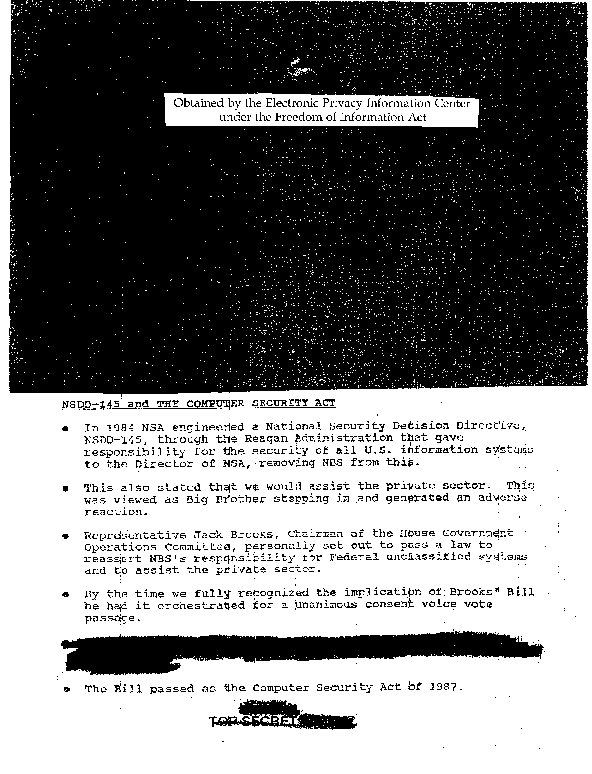
Before the 1987 law was passed however, Clinton Brooks, a Special Assistant to NSA Director Lieutenant General William Odom, wrote a Top Secret Memorandum which stated: “In 1984 NSA engineered a National Security Decision Directive, NSDD-145, through the Reagan Administration that gave responsibility for the security of all US information systems to the Director of NSA, removing NBS [National Bureau of Standards] from this.”

Conceived as a follow-on to the Reagan administration’s infamous 1981 Executive Order 12333, which trashed anemic congressional efforts to rein-in America’s out-of-control spy agencies, NSDD-145 handed power back to the National Security Agency and did so to the detriment of civilian communication networks.

Scarcely a decade after Senator Frank Church warned during post-Watergate hearings into government surveillance abuses, that NSA’s “capability at any time could be turned around on the American people, and no American would have any privacy left, such is the capability to monitor everything: telephone conversations, telegrams, it doesn’t matter . . . there would be no place to hide,” the agency was at it with a vengeance.

“This [NSDD-145] also stated,” Brooks wrote, “that we would assist the private sector. This was viewed as Big Brother stepping in and generated an adverse reaction” in Congress that helped facilitate passage of the Act.

Engineered by future Iran-Contra felon, Admiral John Poindexter, President Reagan’s National Security Adviser who would later serve as President George W. Bush’s Director of DARPA’s Information Awareness Office, the Pentagon satrapy that brought us the Total Information Awareness program, NSDD-145 stated that the “Director, National Security Agency is designated the National Manager for Telecommunications and Automated Information Systems Security.”

NSA’s new mandate meant that the agency would “act as the government focal point for cryptography, telecommunications systems security, and automated information systems security.”
Additionally, NSA would “conduct, approve, or endorse research and development of techniques and equipment for telecommunications and automated information systems security for national security information.”

But it also authorized the agency to do more than that, granting it exclusive authority to “review and approve all standards, techniques, systems and equipments for telecommunications and automated information systems security.” As well, NSA was directed to “enter into agreements for the procurement of technical security material and other equipment, and their provision to government agencies, where appropriate, to private organizations, including government contractors, and foreign governments.”

In other words, NSA was the final arbiter when it came to setting standards for all government and private information systems; quite a coup for the agency responsible for standing-up Project MINARET, the Cold War-era program that spied on thousands of antiwar protesters, civil rights leaders, journalists and members of Congress, as recently declassified documents published by the National Security Archive disclosed.

NSA Games the System
Although the Computer Security Act passed unanimously by voice vote in both Houses of Congress, NSA immediately set-out to undercut the law and did so by suborning the National Bureau of Standards, now the National Institute of Standards and Technology (NIST).

The battle over the Clipper Chip would be the template for future incursions by the agency for the control, through covert infiltration, of regulatory bodies overseeing civilian communications.
According to the Clinton White House, Clipper “would provide Americans with secure telecommunications without compromising the ability of law enforcement agencies to carry out legally authorized wiretaps.”

Neither safe nor secure, Clipper instead would have handed government security agencies the means to monitor all communications while giving criminal networks a leg up to do the same.
In fact, as the Electronic Privacy Information Center (EPIC) discovered in documents unearthed through the Freedom of Information Act, the underlying algorithm deployed in Clipper, Skipjack, had been developed by NSA.

Cryptography expert Matt Blaze wrote a now famous 1994 paper on the subject before the algorithm was declassified, Protocol Failure in the Escrowed Encryption Standard: “The EES cipher algorithm, called ‘Skipjack’, is itself classified, and implementations of the cipher are available to the private sector only within tamper-resistant modules supplied by government-approved vendors. Software implementations of the cipher will not be possible. Although Skipjack, which was designed by the US National Security Agency (NSA), was reviewed by a small panel of civilian experts who were granted access to the algorithm, the cipher cannot be subjected to the degree of civilian scrutiny ordinarily given to new encryption systems.”

This was precisely as NSA and the Clinton administration intended.

A partially declassified 1993 NSA memo noted that “there will be vocal public doubts expressed about having a classified algorithm in the device we propose for the US law enforcement problem, the CLIPPER chip, we recommend the following to address this.” We don’t know what those agency recommendations were, however; more than 20 years after the memo was written they remain secret.
The memo continued: “If such people agree to this clearance and non disclosure process, we could go over the algorithm with them to let them develop confidence in its security, and we could also let them examine the detail design of the CLIPPER chip made for the US law enforcement problem to assure themselves that there were no trapdoors or other techniques built in. This would likely require crypto-mathematicians for the algorithm examination and microelectronics chip design engineers for the chip examination.”

But the extreme secrecy surrounding Skipjack’s proposed deployment in commercial products was the problem. Even if researchers learned that Clipper was indeed the government-mandated backdoor they feared, non-disclosure of these facts, backed-up by the threat of steep fines or imprisonment would hardly assure anyone of the integrity of this so-called review process.
“By far, the most controversial aspect of the EES system,” Blaze wrote, “is key escrow.”
“As part of the crypto-synchronization process,” Blaze noted, “EES devices generate and exchange a ‘Law Enforcement Access Field’ (LEAF). This field contains a copy of the current session key and is intended to enable a government eavesdropper to recover the cleartext.”

“The LEAF copy of the session key is encrypted with a device-unique key called the ‘unit key,’ assigned at the time the EES device is manufactured. Copies of the unit keys for all EES devices are to be held in ‘escrow’ jointly by two federal agencies that will be charged with releasing the keys to law enforcement under certain conditions.”
What those conditions were however, was far from clear. In fact, as we’ve since learned from Snowden’s cache of secret documents, even when the government seeks surveillance authorization from the FISA court, the court must rely on government assurances that dragnet spying is critical to the nation’s security. Such assurances, FISA court judge Reggie B. Walton noted, were systematically “misrepresented” by secret state agencies.

That’s rather rich considering that Walton presided over the farcical “trial” that upheld Bush administration demands to silence FBI whistleblower Sibel Edmonds under the state secrets privilege. Edmonds, a former contract linguist with the Bureau charged that top FBI officials had systematically covered-up wrongdoing at its language division and had obstructed agents’ attempts to roll-up terrorist networks before and after the 9/11 provocation, facts attested to by FBI whistleblower Coleen Rowley in her 2002 Memo to then-FBI Director Robert Mueller.

In 2009, Walton wrote that “The minimization procedures proposed by the government in each successive application and approved and adopted as binding by the orders of the FISC have been so frequently and systemically violated that it can fairly be said that this critical element of the overall BR regime has never functioned effectively.”

“The Court,” Walton averred, “must have every confidence that the government is doing its utmost to ensure that those responsible for implementation fully comply with the Court’s orders. The Court no longer has such confidence.”

Predating those critical remarks, a heavily-redacted 1993 Memo to then-Special Assistant to the President and future CIA chief, George Tenet, from FBI Director William Sessions noted that NSA “has developed a new encryption methodology and computer chip which affords encryption strength vastly superior to DES [Digital Encryption Standard], yet which allows for real time decryption by law enforcement, acting pursuant to legal process. It is referred to as ‘Clipper’.”

[Two redacted paragraphs] “if the devices are modified to include the ‘Clipper’ chip, they would be of great value to the Federal, state and local law enforcement community, especially in the area of counter narcotics, investigations, where there is a requirement to routinely communicate in a secure fashion.”

But even at the time Sessions’ memo was written, we now know that AT&T provided the Drug Enforcement Administration “routine access” to “an enormous AT&T database that contains the records of decades of Americans’ phone calls,” The New York Times reported, and had done so since 1987 under the auspices of DEA’s Hemisphere Project.

Furthermore, in the wake of Snowden revelations we also learned that listening in on the conversations of drug capos is low on NSA’s list of priorities. However, programs like X-KEYSCORE and TEMPORA, which copies all data flowing along fiber optic cables, encrypted and unencrypted alike, at petabyte scales, is supremely useful when it comes to building profiles of internet users by intelligence agencies.

This was an implicit goal of Clinton administration maneuvers to compel developers to insert Clipper into their product designs.

According to Sessions, “the ‘Clipper’ methodology envisions the participation of three distinct types of parties.” [Redacted] It is proposed that the second party, the two custodians of the ‘split’ key infostructure [sic], be comprised of two disinterested and trustworthy non law enforcement Government agencies or entities. Although, such decision and selection are left for the Administration, a list of reccommended [sic] agencies and entities has been prepared (and included in the text), [redacted]. This party would administer and oversee all facets of the ‘Clipper’ program and methodology.”

Based on NSDD-145′s mandate, one can assume “this party” would be NSA, the agency that designed the underlying algorithm that powered Clipper.

The Sessions memo averred: “The Clipper chip provides law enforcement access by using a special chip key, unique to each device. In the AT&T TSD 3600, a unique session key is generated, external to the Clipper chip for each call.”
“This session key,” the memo explained, “is given to the chip to control the encryption algorithm. A device unique ‘chip key’ is programmed into each Clipper at the time of manufacture. When two TSD 3600s go to secure operation, the device gives out its identification (ID) number and the session key encrypted in its chip key.”
Underlining a key problem with Clipper technology Sessions noted, “Anyone with access to the chip key for that identified device will be able to recover the session key and listen to the transmission simultaneously with the intended receiver. This design means that the list of chip keys associated with the chip ID number provides access to all Clipper secured devices, and thus the list must be carefully generated and protected. Loss of the list would preclude legitmate [sic] access to the encrypted information and compromise of the list could allow unauthorized access.”

In fact, that “anyone” could include fabulously wealthy drug gangs or bent corporations with the wherewithal to buy chip keys from suborned government key escrow agents!

Its ubiquity would be a key selling-point for universal deployment. The memo explained, “the NSA developed chip based ‘Clipper’ solution works with hardware encryption applications, such as those which might be used with regard to certain telecommunications and computers devices,” which of course would allow unlimited spying by “law enforcement.”

Such vulnerabilities built into EES chip keys by design not only enabled widespread government monitoring of internet and voice traffic, but with a few tweaks by encryption-savvy “rogues” could be exploited by criminal organizations.

In his 1994 paper Blaze wrote that “a rogue system can be constructed with little more than a software modification to a legal system. Furthermore, while some expertise may be required to install and operate a rogue version of an existing system, it is likely that little or no special skill would be required to install and operate the modified software.”

“In particular,” Blaze noted, “one can imagine ‘patches’ to defeat key escrow in EES-based systems being distributed over networks such as the Internet in much the same way that other software is distributed today.”

In the intervening years since Blaze observed how easy it would be to compromise key escrow systems by various bad actors, governments or criminals take your pick, the proliferation of malware powered botnets that infect hundreds of thousands of computers and smart phones every day–for blanket surveillance, fraud, or both–is a fact of life.

It didn’t help matters when it emerged that “escrow agents” empowered to unlock encrypted communications would be drawn from the National Institute of Standards and Technology and the Automated Services Division of the Treasury Department, government outposts riddled with “No Such Agency” moles.

As EPIC pointed out, “Since the enactment of the Computer Security Act, the NSA has sought to undercut NIST’s authority. In 1989, NSA signed a Memorandum of Understanding (MOU) which purported to transfer back to NSA the authority given to NIST.”

The MOU required that NIST request NSA’s “assistance” on all matters related to civilian cryptography. In fact, were NIST and NSA representatives on the Technical Working Group to disagree on standards, the ultimate authority for resolving disputes would rest solely with the Executive Branch acting through the President, the Secretary of Defense and the National Security Council, thus undercutting the clear intent of Congress when they passed the 1987 Computer Security Act.

EPIC noted:
“The memorandum effectively returned to NSA many of the powers rejected by the Computer Security Act. The MOU contained several key goals that were to NSA’s benefit, including: NSA providing NIST with ‘technical security guidelines in trusted technology, telecommunications security, and personal identification that may be used in cost-effective systems for protecting sensitive computer data;’ NSA ‘initiating research and development programs in trusted technology, telecommunications security, cryptographic techniques and personal identification methods’; and NSA being responsive to NIST ‘in all matters related to cryptographic algorithms and cryptographic techniques including but not limited to research, development, evaluation, or endorsement’.”
A critique of the Memorandum in 1989 congressional testimony by the General Accounting Office (GAO) emphasized: “At issue is the degree to which responsibilities vested in NIST under the act are being subverted by the role assigned to NSA under the memorandum. The Congress, as a fundamental purpose in passing the act, sought to clearly place responsibility for the computer security of sensitive, unclassified information in a civil agency rather than in the Department of Defense. As we read the MOU, it would appear that NIST has granted NSA more than the consultative role envisioned in the act.”

Five years after the GAO’s critical appraisal, NSA’s coup was complete.

“In 1994,” EPIC noted,
“President Clinton issued Presidential Decision Directive (PDD-29). This directive created the Security Policy Board, which has recommended that all computer security functions for the government be merged under NSA control.”
Since PDD-29 was issued matters have only gotten worse. In fact, NIST is the same outfit exposed in Snowden documents published by The Guardian and The New York Times that allowed NSA to water down encryption and build backdoors into the Dual EC DRBG standard adopted by the Institute in 2006.

“Eventually, NSA became the sole editor.”

Besieged by widespread opposition, the Clinton administration was out maneuvered in the court of public opinion and by 1996 had abandoned Clipper. However, this proved to be a pyrrhic victory for security-minded researchers and civil libertarians as we have since learned from Edward Snowden’s revelations.

Befitting a military-intelligence agency, the dark core of America’s deep state, NSA was fighting a long war–and they were playing for keeps.

________


Reprinted with permission from Center for Research in Globalization.

6 Months After Obama Promised to Divulge More on Drones, Here's What We Still Don't Know

by Cora Currier ProPublica, Nov. 5, 2013, 2:23 p.m.
November 6
: This story has been updated to reflect new developments.
Nearly six months ago, President Obama promised more transparency and tighter policies around targeted killings. In a speech, Obama vowed that the U.S. would only use force against a "continuing and imminent threat to the American people." It would fire only when there was "near-certainty" civilians would not be killed or injured, and when capture was not feasible. The number of drone strikes has dropped this year, but they've continued to make headlines. On Friday, a U.S. drone killed the head of the Pakistani Taliban. A few days earlier came the first drone strike in Somalia in nearly two years. How much has changed since the president's speech?

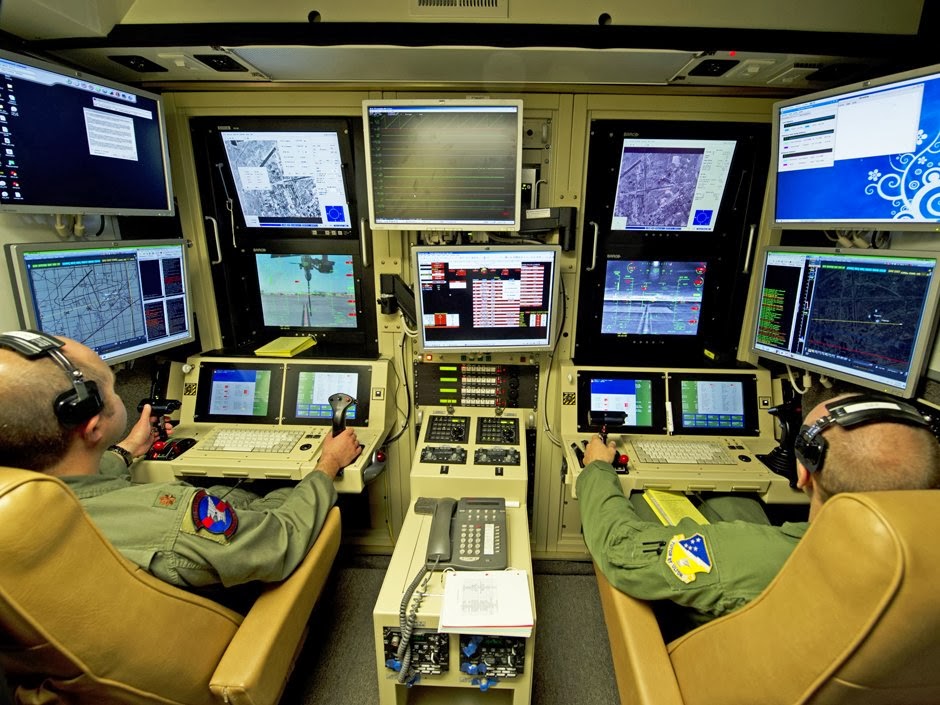
Drone ground station (USAF).
 
We don't know the U.S. count of civilian deaths

The administration says that it has a count of civilian deaths, and that there is a "wide gap" between U.S. and independent figures. But the administration won't release its own figures. Outside estimates of total civilian deaths since 2002 range from just over 200 to more than 1,000.  The Pakistani government has given three different numbers: 400, 147, and 67. McClatchy and the Washington Post obtained intelligence documents showing that for long stretches of time, the CIA estimated few or no civilian deaths. The documents also confirmed the use of signature strikes, in which the U.S. targets people without knowing their identity. The CIA categorized many of those killed as simply "other militants" or "foreign fighters." The Post wrote that the agency sometimes designated "militants" with what seemed like circumstantial or vague evidence, such as "men who were probably' involved in cross-border attacks" in Afghanistan.

RQ-1 Predator aircraft, Tallil Air Base, (AB), Iraq.
The administration reportedly curtailed signature strikes this year, though the new guidelines don't necessarily preclude them. A White House factsheet released around Obama's speech said that "it is not the case that all military-aged males in the vicinity of a target are deemed to be combatants." It did not say that people must be identified. (In any case, the U.S. has not officially acknowledged the policy of signature strikes.)

Attorney General Eric Holder confirmed only that four Americans have been killed by drone strikes since 2009: Anwar al Awlaki and his sixteen-year-old son, Abdulrahman, Samir Khan, and Jude Kenan Mohammed. Holder said that only the elder Awlaki was "specifically targeted," but did not explain how the others came to be killed. Although Obama said that this disclosure was intended to "facilitate transparency and debate," since then, the administration has not commented on specific allegations of civilian deaths.

We don't know exactly who can be targeted
The list of groups that the military considers "associated forces" of Al Qaeda is classified. The administration has declared that it targets members of Al Qaeda in the Arabian Peninsula, and "elements" of Al Shabaab, but there are still questions about how the U.S. determines that an individual belonging to those groups is in fact a "continuing and imminent threat." (After the terror alarm that led to the closing of U.S. embassies this summer, officials told the New York Times they had "expanded the scope of people [they] could go after" in Yemen.) This ties into the debate over civilian casualties: The government would seem to consider some people legitimate targets that others don't.
 
Amnesty International and Human Rights Watch conducted in-depth studies of particular strikes in Pakistan and Yemen, respectively. They include eyewitness reports of civilian deaths. (Most of the deaths investigated happened before the Obama administration's new policies were announced, although the administration has not said when those guidelines went into effect.) The reports also raised questions of the legality of specific strikes, questioning whether the deaths were all unavoidable casualties of legitimate attacks.It does not appear that the U.S. plans to expand strikes against Al Qaeda to other countries — officials have reportedly told Iraq, for example, it won't send drones there. But the U.S. has established a surveillance drone base in Niger, and fed information from drones to French forces fighting in Mali.

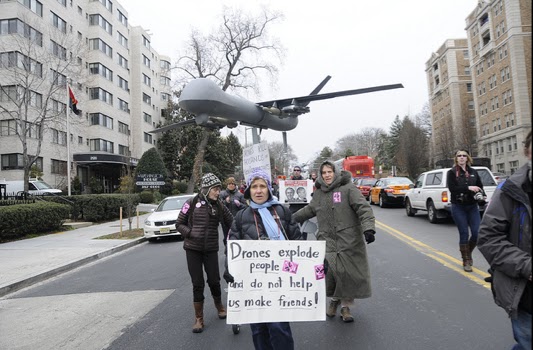
"Drones Kill People" - Protesters at President Obama's inauguration 2012 (Photo: Debra Sweet).


We don't know if the U.S. compensates civilian casualties
CIA director John Brennan suggested during his confirmation hearing that the U.S. made condolence payments to harmed families. But there is little evidence of it happening. U.S. Central Command told ProPublica that it had 33 pages related to condolence payments — but wouldn't release any of them to us.

We don't always know which strikes are American
While unnamed officials sometimes confirm that strikes came from U.S. drones, other attacks may be from Pakistani, Yemeni, or even Saudi planes. (It's also worth noting that the U.S. has also used cruise missiles and Special Forces raids. But the bulk of U.S. counterterrorism actions outside Afghanistan in recent years appear to rely on drones.)

We don't know the precise legal rationale behind the strikes
Some members of Congress have seen the legal memos behind targeted killing of U.S. citizens. But lawmakers were not granted access to all memos on the program. Legislation pending in the Senate would require the administration to give the Intelligence Committees a list of such legal opinions.
Other congressmen have introduced bills with more reporting requirements for targeted killings. (Proposals for a "drone court" for oversight have not gotten very far.)

"Reaper" Drone - Even deadlier than the Predator Drone.
It's far from clear that any of that additional oversight would lead to public disclosure. The government and the American Civil Liberties Union and the New York Times are still locked in court battles over requests for drone documents. While a judge has ruled the CIA can no longer assert the "fiction" that it can't reveal if it has any interest in drones, the agency hasn't been compelled to release any information yet. The government has also so far fought off disclosure of legal memos underpinning targeted killings.

And here are some things we've learned through leaks and independent reporting:
How the U.S. tracks targets: Documents provided by Edward Snowden to the Washington Post detailed the NSA's "extensive involvement." Lawyers in a terrorism-related case also uncovered reports that government surveillance of their client may have led to a drone strike in Somalia. The Atlantic published a detailed account of Yemen using a child to plant a tracking chip on a man who was killed in a U.S. strike.

What people in the countries affected think: The Pakistani government's cooperation with at least some U.S. drone strikes—long an open secret—has now been well-documented. Public sentiment in the country is vividly anti-drone, even when violent Taliban commanders are killed, and politicians continue to denounce them as American interference. Limited polling in the region most affected by drones is contradictory, with some saying that at the very least, they prefer drones to the Pakistani military campaigns. Life in those areas is between a drone and a hard place: Residents told Amnesty International of the psychological toll from drones, and they also face reprisals from militants who accuse them of spying.

A Predator drone fires a missile.
Yemen's president continues to openly embrace U.S. strikes, though the public generally opposes them —particularly those strikes that hit lower-level fighters, or those whose affiliations with Al Qaeda aren't clear. Foreign Policy recently detailed the aftermath of an August strike where two teenagers died. Their family disputes they had any link to terrorism.

The physical infrastructure: More of the network of drone bases across the world has been revealed — from the unmasking of a secret base in Saudi Arabia to the fact that drones had to be moved off the U.S. base in Djibouti, in the Horn of Africa, after crashes and fear of collision with passenger planes.

The CIA's role: The administration had reportedly planned to scale back the CIA's role in targeted killing, moving control of much of the drone program to the military. But the CIA reportedly still handles strikes in Pakistan and has a role in Yemen as well. Officials told Foreign Policy yesterday that the transition won't happen anytime soon.

The history of the programs: Revelations continue to change our understanding of the contours of the drone war, but two books published this year offer comprehensive accounts — The Way of the Knife, by Mark Mazzetti of the New York Times, and Dirty Wars, by Jeremy Scahill.


Reprinted with permission from ProPublica.